
There are places that impress you immediately. Alentejo works differently.
At first, it is the space you notice. Endless horizons, golden fields, cork oak forests, vineyards and small whitewashed villages separated by miles of remarkably quiet roads.
Then you begin to notice everything else.
A medieval castle appearing on a distant hilltop. A tiny village café where everyone seems to know each other. Vineyards surrounding roads with almost no traffic. Long lunches built around bread, olive oil, local cheese and wine. And a rhythm of life that seems perfectly suited to travelling by bicycle.
For us, this is what makes cycling Alentejo so special.
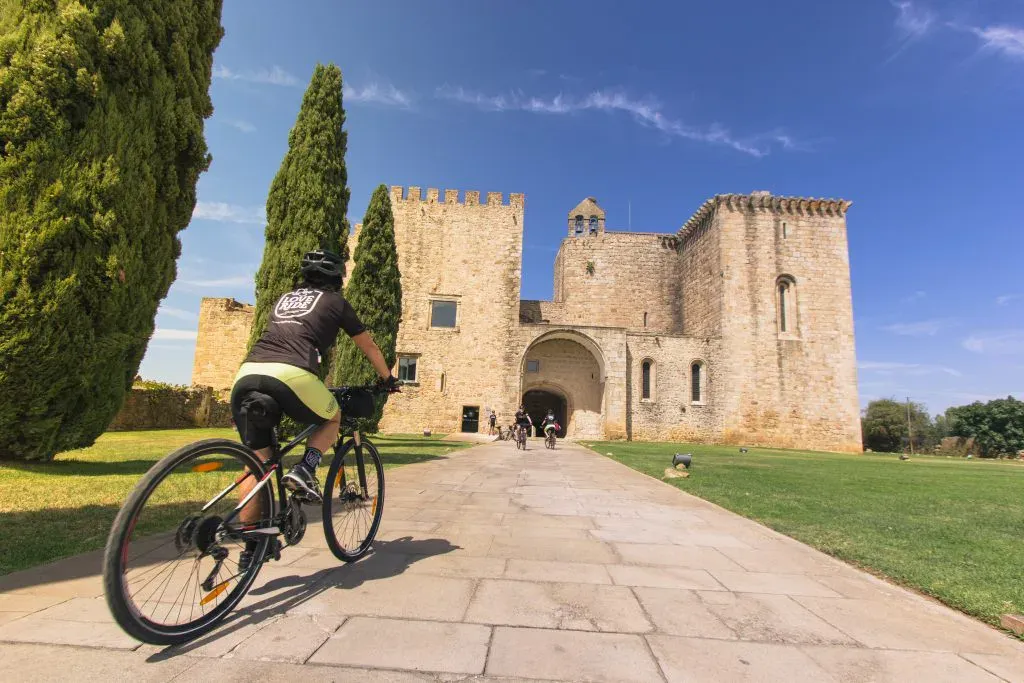
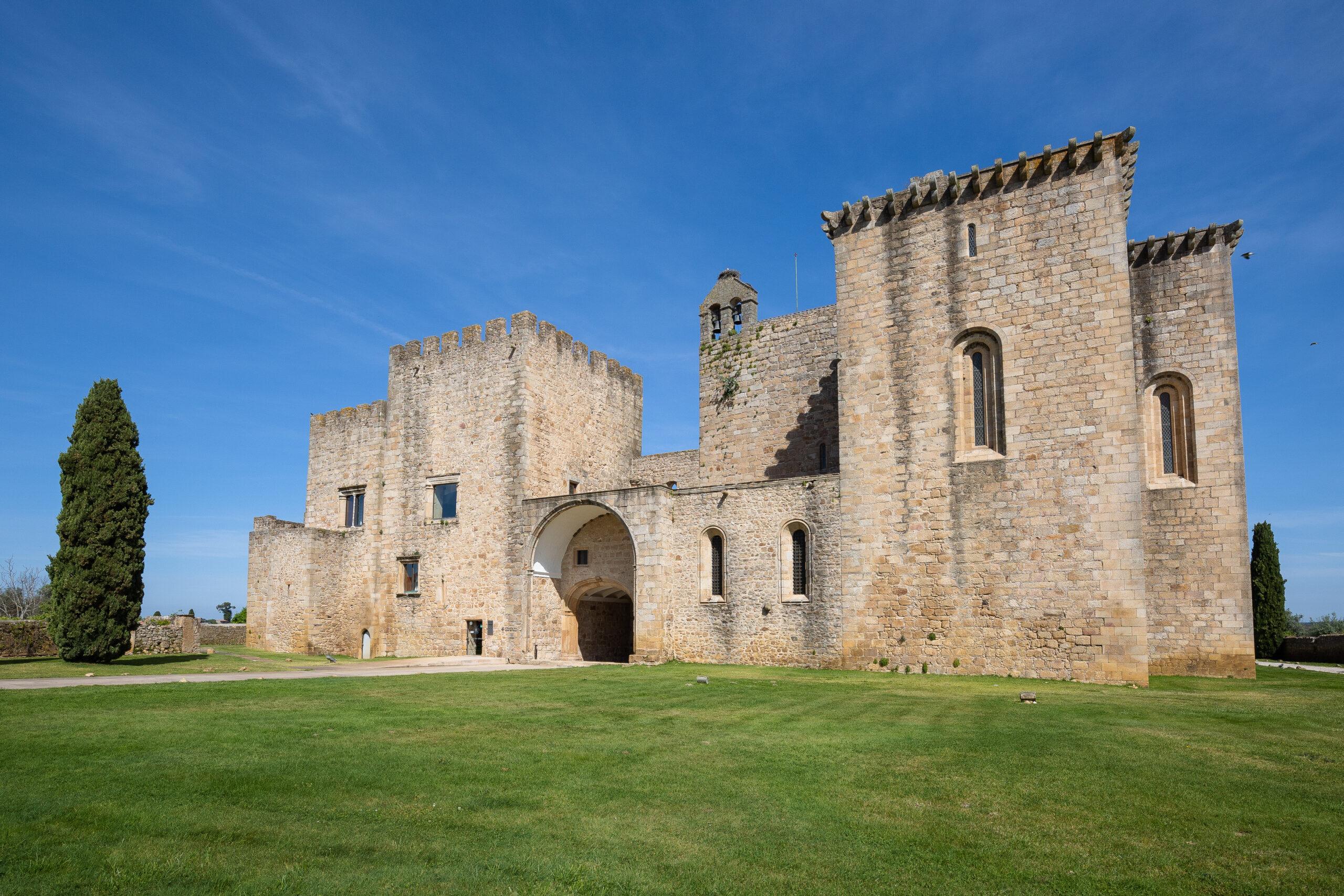
A cyclist in a bike tour approaches the Flor da Rosa Monastery, a 14th-century gem turned boutique hotel.
Alentejo offers a wonderful balance for cyclists who want genuinely great riding without making every day a test of the legs. The roads are quiet, beautifully surfaced and predominantly rolling, with enough climbing to keep the riding interesting but plenty of time and energy left to explore a castle, visit a winery, enjoy a long lunch or wander through a historic village at the end of the day.
That combination of cycling, culture, gastronomy and a slower rhythm of travel is what sets Alentejo apart from many of Europe’s better known cycling destinations.
And this region is particularly close to us at Live Love Ride.
We’ve been operating cycling tours in Alentejo since 2014, and two members of our team were born and raised here, in the Estremoz region. They bring something to our journeys that you simply can’t learn from a guidebook: an understanding of the villages, people, traditions, food and wonderfully distinctive Alentejo character that comes from calling this region home.
Over the years, we’ve ridden these roads hundreds of times with guests, continually refining our routes, discovering new places to stop and returning to the restaurants, wineries and small villages that make us fall in love with Alentejo all over again.
The landscape also changes considerably as you travel through the region.
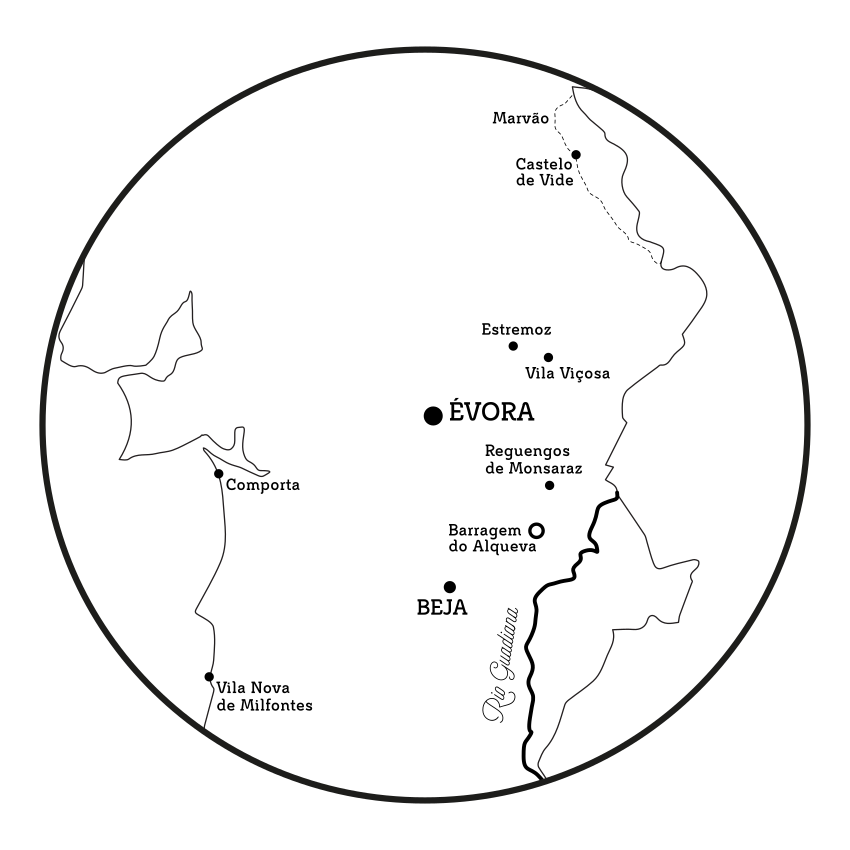
In the north, around Marvão and Castelo de Vide, you’ll encounter the granite landscapes and more challenging climbs of the Serra de São Mamede. Around Estremoz and Vila Viçosa, vineyards, olive groves and historic marble towns dominate the scenery. Further south, Monsaraz and Lake Alqueva offer enormous horizons and some of the region’s most spectacular sunsets, while Évora, a UNESCO World Heritage city, brings Roman history, medieval architecture and one of Portugal’s great gastronomic traditions into the journey.
This guide brings together more than a decade of our experience cycling in Alentejo to help you understand where to ride, the best routes and towns to visit, when to travel, what type of bike to choose and how to plan a cycling holiday in one of Portugal’s most rewarding regions.
If the Douro is about dramatic climbs and terraced valleys, Alentejo offers a very different kind of cycling.
Here, the pleasure comes from the rhythm of the ride.
Long stretches of quiet country road roll through cork oak forests, vineyards, olive groves and open farmland. Traffic can be remarkably light, and the terrain is generally undulating rather than mountainous. There are certainly climbs, particularly around the Serra de São Mamede and the region’s spectacular hilltop villages, but Alentejo rarely feels like a destination where the day’s objective is simply to conquer another mountain.
That makes it one of our favourite regions for cyclists who want to combine rewarding riding with everything that happens away from the bike.
You can ride 50 or 60 kilometres in the morning and still have the afternoon to visit a winery. Stop for coffee beneath a medieval castle. Walk through the streets of a UNESCO World Heritage city. Visit a local pottery workshop. Or simply settle into a long Alentejo lunch with a bottle of local wine.
History is everywhere. Roman ruins, prehistoric monuments, medieval castles, fortified villages, convents and centuries old farm estates appear throughout the countryside, often connected by the same peaceful backroads we love to ride.
And then there is the food.
Alentejo is one of Portugal’s great gastronomic regions, known for exceptional olive oil, bread, cured meats, sheep cheeses, pork, lamb, aromatic herbs and some of the country’s most respected wines. Here, lunch is not something squeezed between two rides. It is part of the journey.
After running tours here since 2014, we’ve found that this balance is precisely what surprises many of our guests. They arrive expecting beautiful cycling and leave talking just as much about the people they met, the villages they explored and the meals they shared.
Best time to go: March to May and September to November.
Best suited for: Leisure to intermediate cyclists, couples, food and wine lovers, and riders who want to combine great cycling with culture and local experiences.
Recommended bike: Road bike, gravel bike or E-bike.
Terrain: Predominantly rolling, with occasional longer or steeper climbs around hilltop villages and the Serra de São Mamede.
Recommended duration: 5 to 7 days.
Two members of our team grew up in Alentejo, and if there’s one thing they’ll tell you, it’s not to rush it. Alentejo has its own character and its own pace. Stop for the coffee. Talk to the person behind the counter. Walk into the little bakery. Stay longer over lunch than you planned. Ask what the local wine is.
The cycling here is excellent, but Alentejo really reveals itself in everything that happens between the rides.
Alentejo is enormous, and that is part of its appeal. The cycling changes considerably as you travel from the granite mountains of the north to the vineyards of central Alentejo, the Guadiana Valley and eventually the wild Atlantic coast.
After operating tours here since 2014, we have developed our own favourite ways of connecting these places. Some follow beautifully surfaced country roads. Others use tiny backroads or gravel tracks that rarely appear in conventional cycling itineraries.
These are some of the places, and roads, we keep returning to.
Northern Alentejo offers some of the region’s most dramatic cycling. The Serra de São Mamede Natural Park rises unexpectedly from the surrounding plains, bringing greener landscapes, granite outcrops, forests and considerably more climbing than you’ll encounter further south.
Castelo de Vide makes an excellent starting point. Its whitewashed streets climb towards the medieval castle, while the old Jewish quarter, fountains and small squares are worth exploring before getting back on the bike.
Above it all sits Marvão, one of Portugal’s most spectacular fortified villages. Perched on a granite ridge more than 800 metres above sea level, its walls command enormous views across Alentejo and neighbouring Spain.
The climb requires some effort, but riding through the medieval gates at the top is one of our favourite arrivals anywhere in Portugal.
There are two very different ways we particularly enjoy riding this area.
For something more adventurous, explore the rugged backroads around Beirã, where tiny roads wind through granite landscapes, cork forests and almost forgotten corners of northern Alentejo.
For road cyclists, the descent from Marvão towards Portalegre is beautiful, and riding it in the opposite direction turns it into one of the region’s most rewarding climbs. This is Alentejo at its hillier and more dramatic best.
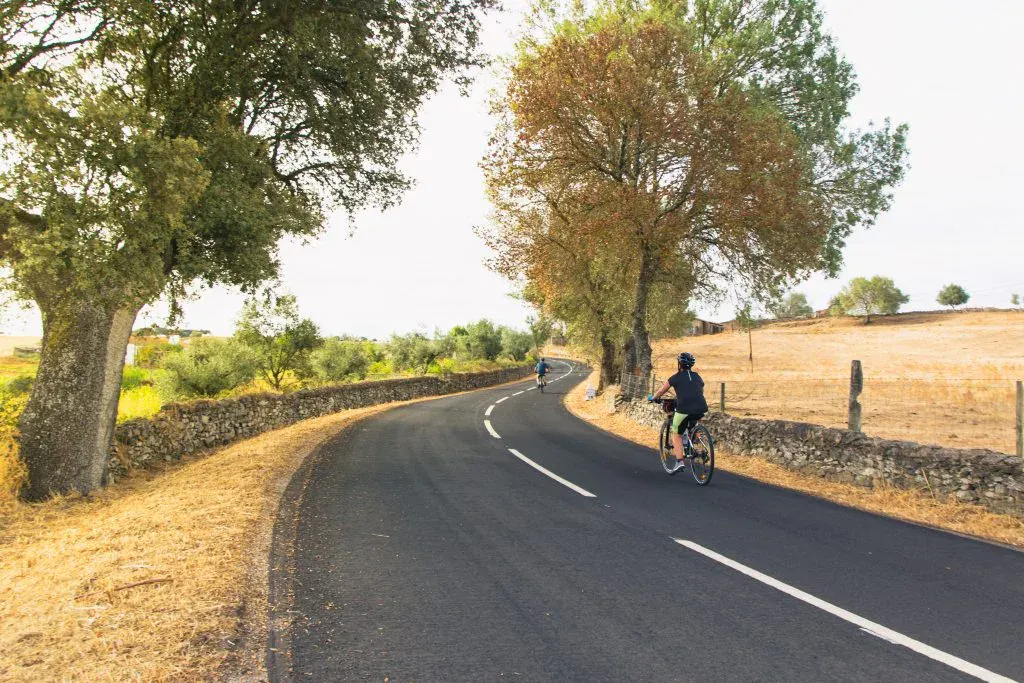
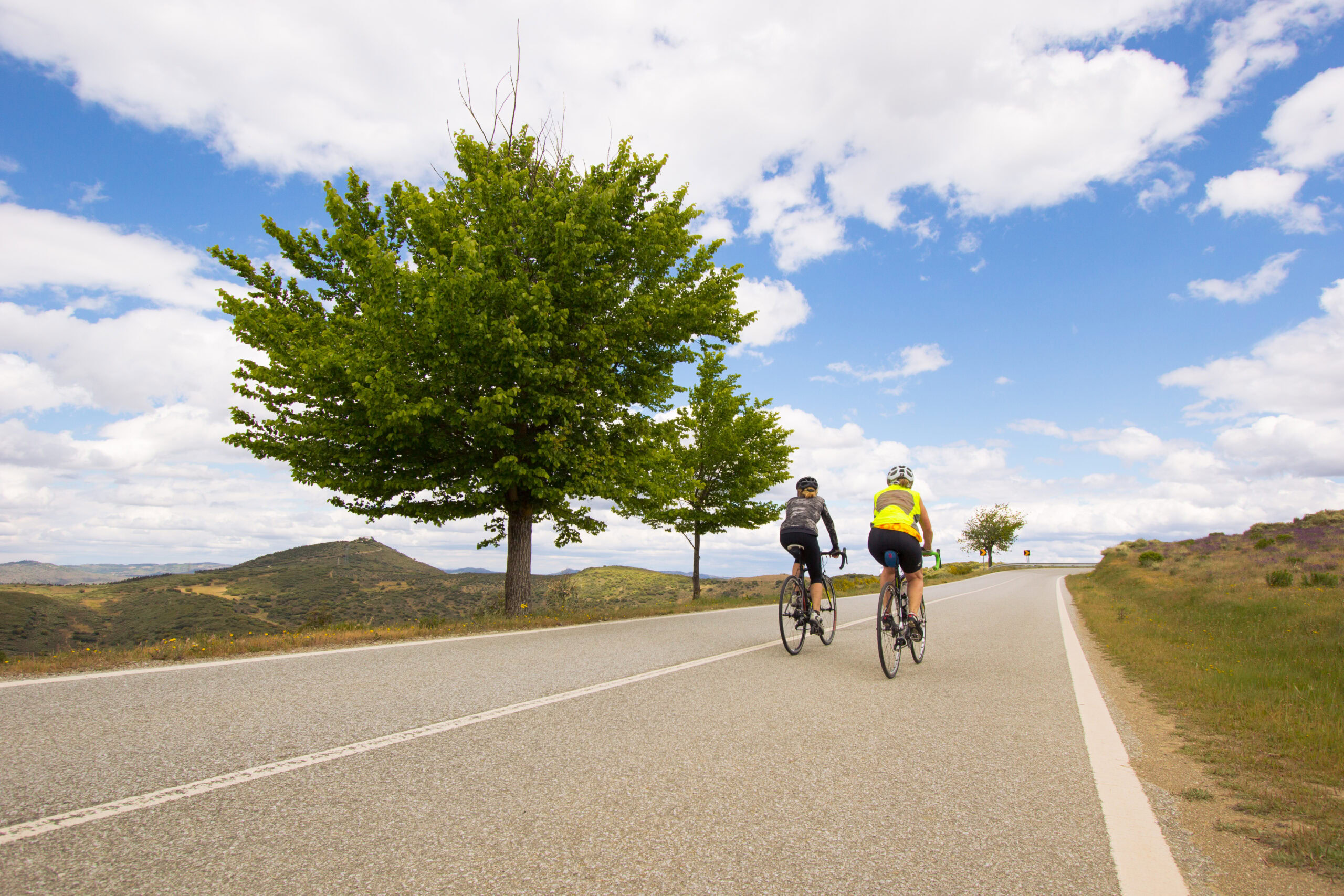
Quiet backroads and golden landscapes make Alentejo a dream destination for cycling enthusiasts.
South of Marvão, the landscape begins to open and the cycling becomes gentler. This is where you start to experience the long, peaceful country roads that define much of Alentejo.
Near Crato, Flor da Rosa is home to the impressive Mosteiro de Santa Maria de Flor da Rosa, a fortified medieval monastery that seems almost oversized for the tiny village surrounding it.
But some of our favourite riding here happens between the destinations.
The secondary roads around Crato are exceptionally quiet, crossing cork oak forests, farmland and small villages where traffic can be almost nonexistent.
From here, you can also ride towards Alter do Chão, a town with a centuries old connection to the Lusitano horse.
The famous Coudelaria de Alter has been breeding Lusitano horses since the 18th century and makes a fascinating stop that introduces another side of Alentejo culture beyond wine, castles and cycling.
Don’t always choose the most direct road between Crato and Alter do Chão. The smaller agricultural roads are part of the experience here. This is classic Alentejo cycling: rolling rather than difficult, wonderfully peaceful and with enough time left in the day to visit the stud farm and learn about Portugal’s Lusitano horses.
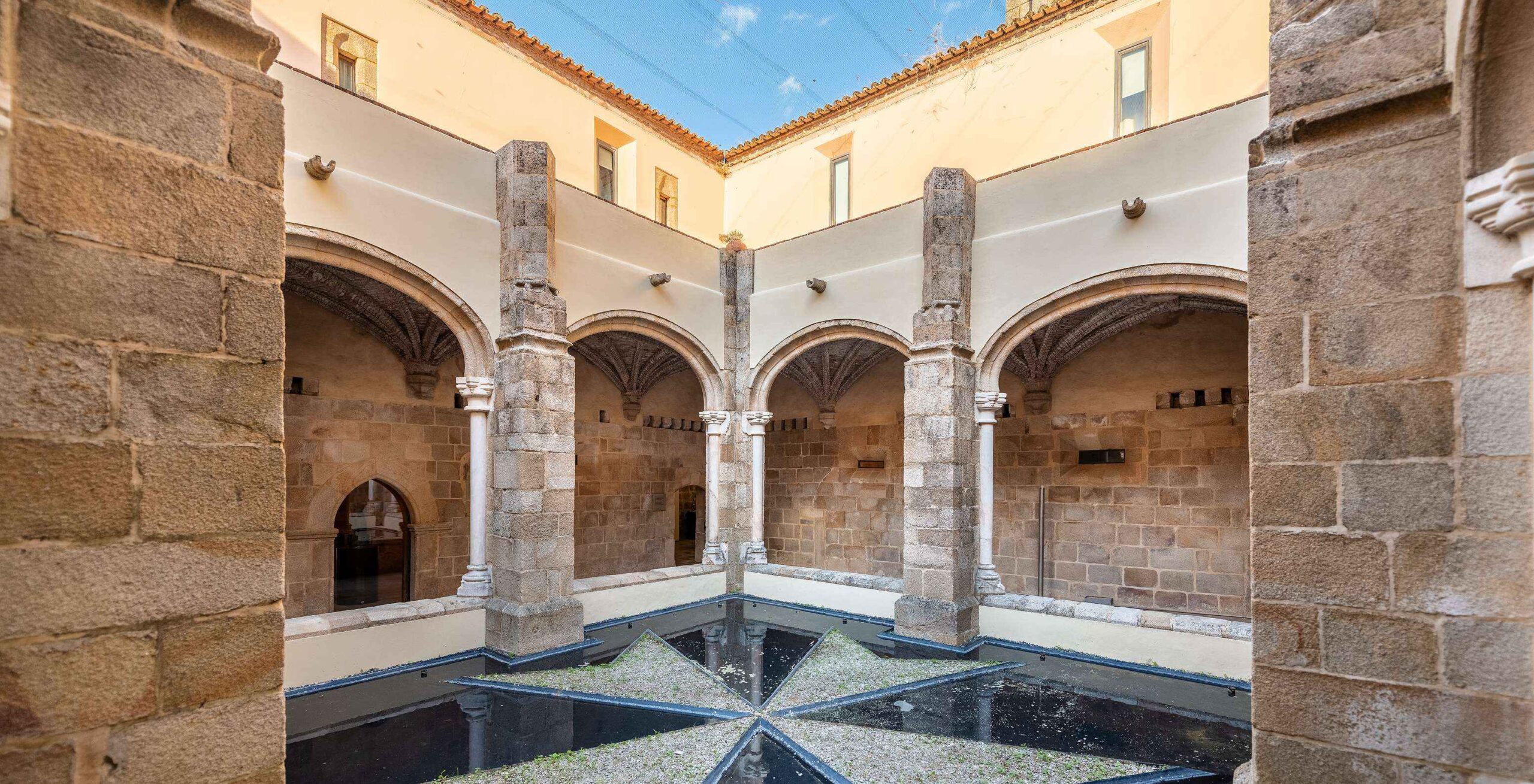
Around Estremoz, vineyards become increasingly prominent and cycling begins to merge naturally with one of the other great reasons to visit Alentejo: its wine.
Estremoz itself rises above the surrounding countryside, with its medieval upper town, castle and distinctive marble tower visible from miles away.
The surrounding roads are excellent for cycling, passing vineyards, olive groves, cork oak forests and some of Portugal’s most important wine estates.
But riders looking for something more challenging should head towards the Serra d’Ossa.
The mountain range breaks up the otherwise rolling landscape and provides one of our favourite road cycling detours in central Alentejo.
Climb into the Serra d’Ossa rather than simply riding around it. The ascent is beautiful, surrounded by forest and increasingly expansive views, while the descent on the other side is one of those roads that makes you want to turn around and ride it again.
It’s enough climbing to give stronger riders a proper challenge without turning the entire day into a mountain stage.
It’s enough climbing to give stronger riders a proper challenge without turning the entire day into a mountain stage.

Vila Viçosa is one of the most elegant small towns in Portugal and the cultural centre of Alentejo’s famous marble region.
Marble is everywhere. You’ll find it in churches, pavements, fountains, doorways and ordinary houses, while enormous quarries around Vila Viçosa, Borba and Estremoz reveal the scale of the industry that has shaped this area for centuries.
The town’s highlight is the magnificent Paço Ducal de Vila Viçosa, once home to the Dukes of Braganza and later closely associated with the Portuguese royal family.
Don’t simply connect Estremoz and Vila Viçosa using the obvious roads. Some of the smaller backroads through the marble country provide much more interesting cycling, passing vineyards, quarries, olive groves and tiny settlements.
Then leave enough time to get off the bike in Vila Viçosa. The Ducal Palace deserves a proper visit rather than a photograph from the square.
South of Vila Viçosa, Alentejo seems to become even quieter.
Alandroal is a small fortified town surrounded by cork forests, olive groves and increasingly open landscapes close to the Spanish border.
From here, the roads towards Monsaraz provide some of the most satisfying cycling in the region. The terrain rolls gently across the countryside and the enormous Alqueva landscape gradually begins to appear.
Eventually, you see Monsaraz sitting impossibly high above the plains.
Time the day so that you don’t reach Monsaraz too early.
The final climb to the medieval village is one of our favourite finishes to a ride in Alentejo, but it becomes even more memorable in the late afternoon. Get off the bike, walk through the cobbled streets and climb to the castle walls for sunset over Lake Alqueva.
It’s difficult to imagine a better way to finish a day on the bike.
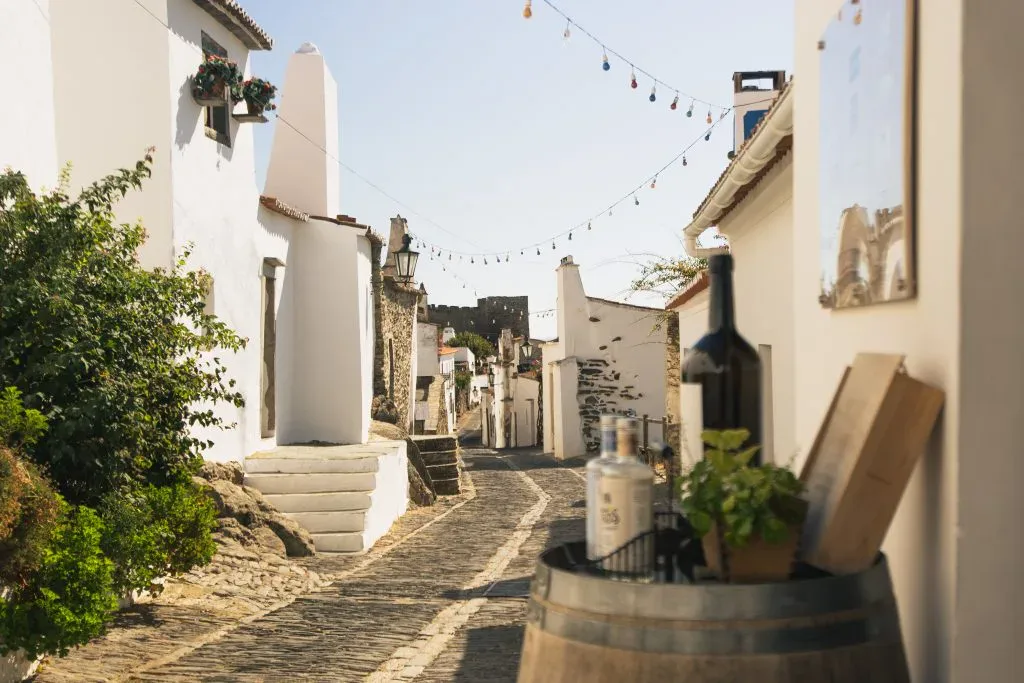
Monsaraz, one of Portugal’s most charming hilltop villages, blends history, wine, and warm hospitality.
Lake Alqueva completely changes the character of the landscape.
One of the largest artificial lakes in Western Europe, it creates an enormous network of quiet bays, peninsulas, islands and waterside roads beneath some of the clearest skies in Portugal.
While Monsaraz receives most of the attention, we also love riding further south towards Mourão.
The roads are peaceful and the lake is almost constantly present, creating a very different cycling experience from the vineyards around Estremoz or the mountains around Marvão.
Ride towards the fluvial beaches around Mourão and, when the weather allows, take a swim in Lake Alqueva.
Afterwards, head into Mourão for a proper Alentejo meal. One of our favourite stops is Adega Velha, the kind of traditional restaurant where the food is as important to the day’s experience as the cycling.
Ride, swim, eat. That’s a pretty good Alentejo afternoon.
A short distance from Monsaraz lies São Pedro do Corval, one of Portugal’s most important pottery villages.
Pottery has been part of life here for generations, and workshops throughout the village still produce traditional pieces by hand. Stop, step inside one of the workshops and watch the potters at work before continuing your ride.
From here, however, there’s another road we particularly enjoy.
Head towards Castelo de Valongo on the narrow agricultural roads through the countryside.
Be warned that these are not immaculate cycling roads. Agricultural machinery and tractors can leave some sections rough or damaged, so you need to pay attention to the surface.
But that’s also why we like them.
The roads are tiny, rural and wonderfully removed from the better known routes through the region. On the right bike, and particularly on a gravel bike, this is a beautiful way to experience a more agricultural and less polished side of Alentejo.
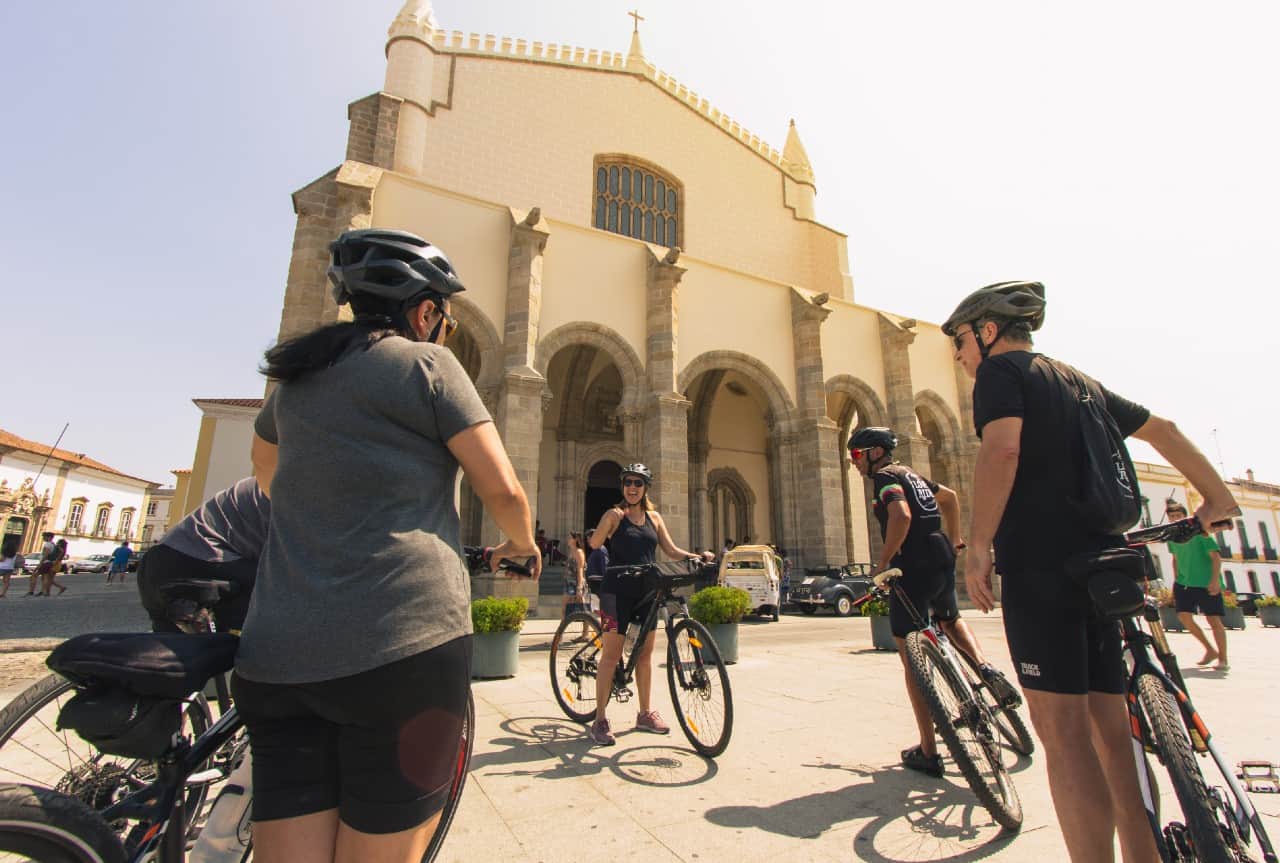
Évora is the cultural heart of Alentejo and one of Portugal’s great historic cities.
Its UNESCO listed centre contains more than two thousand years of history, including the Roman Temple, cathedral, medieval streets and the famous Chapel of Bones.
Our advice for Évora itself is simple: get off the bike.
The historic centre is compact and best discovered on foot. Walk through the streets, visit the monuments and allow yourself time for a proper meal.
But outside the walls, a gravel bike opens up a completely different side of Évora.
One of our favourite gravel excursions heads west into the cork oak countryside towards the Almendres Cromlech, one of the most important prehistoric megalithic sites on the Iberian Peninsula.
From Évora you can also explore north towards Arraiolos through the smaller roads and tracks around Igrejinha, combining open countryside with cork forests and traditional villages.
Wine lovers can build stops around estates such as Cartuxa and Fitapreta, both close enough to Évora to become part of a cycling day rather than requiring a separate excursion.
This combination of gravel riding, prehistoric history, wine and one of Portugal’s most beautiful cities makes Évora an excellent base for spending more than a single night.
Further south, the Guadiana Valley Natural Park introduces another completely different Alentejo landscape.
The Guadiana River cuts through a wilder and more sparsely populated part of the region, surrounded by rolling hills, Mediterranean vegetation, traditional farms and historic towns such as Mértola.
Mértola is one of the most fascinating towns in southern Portugal. Sitting high above the Guadiana, it reflects centuries of Roman, Islamic and Christian history and feels very different from Évora, Estremoz or Monsaraz.
For cyclists, this is particularly interesting gravel territory. Rural tracks, farm roads and quiet lanes allow you to explore landscapes that would be difficult to appreciate from the main roads.
This is one of the areas where we particularly like using a gravel bike. Leaving the asphalt opens up remote landscapes, riverside sections and small rural communities that most visitors to Alentejo never experience.
It’s also why we’ve incorporated this part of the region into our gravel cycling itineraries. The objective isn’t technical mountain biking. It’s using the gravel bike as a tool to reach places that would otherwise remain hidden.
Eventually, Alentejo reaches the Atlantic.
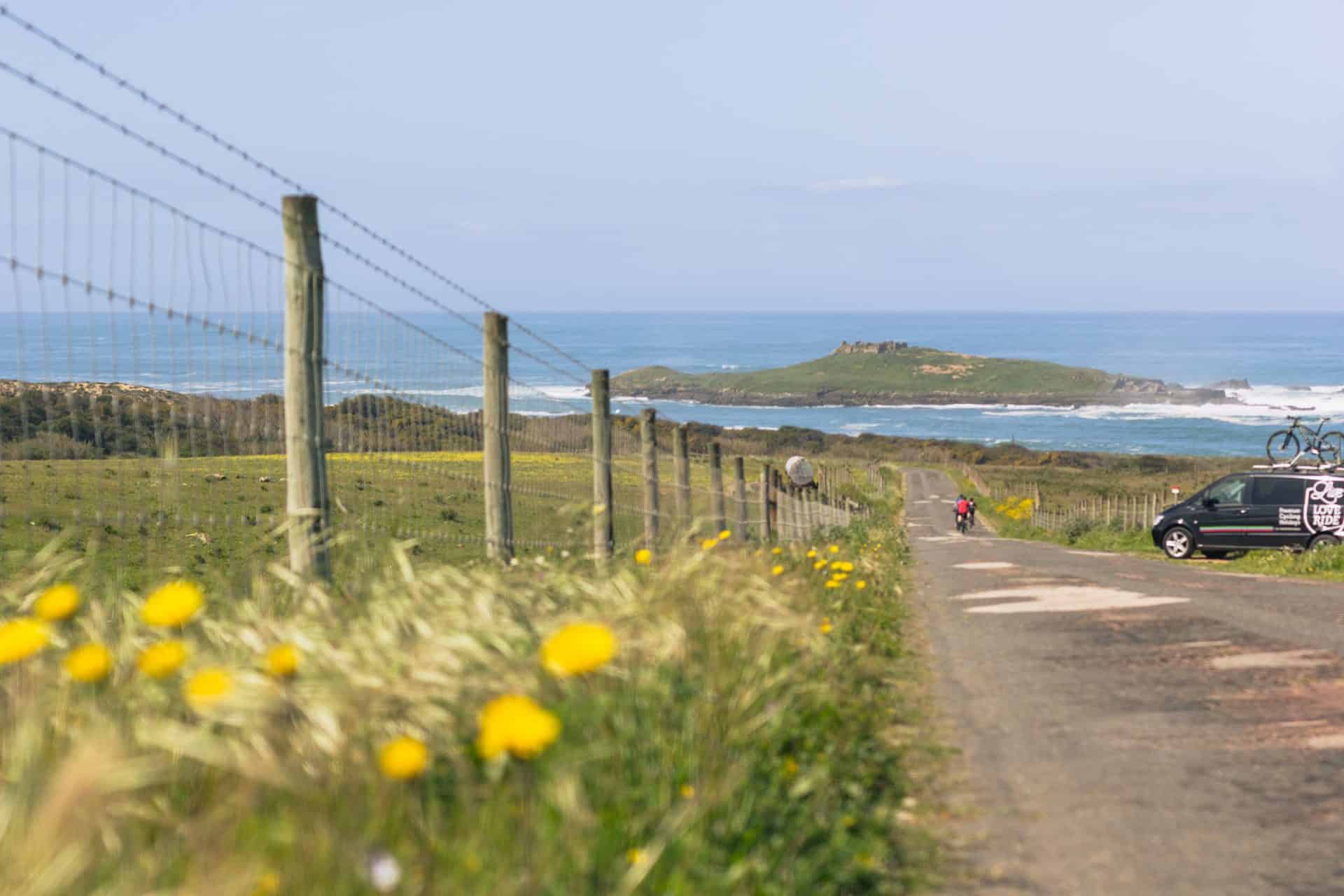
The Southwest Alentejo and Vicentine Coast Natural Park protects one of the wildest stretches of coastline in southern Europe, where high cliffs fall into the Atlantic, fishing villages sit above secluded beaches and the landscape feels dramatically different from inland Alentejo.
This is the world of Porto Covo, Vila Nova de Milfontes, Almograve and Zambujeira do Mar, and it provides an entirely different kind of cycling holiday.
The famous Rota Vicentina has helped make the region internationally known for walking, but the surrounding network of quiet roads and gravel tracks also creates superb opportunities for cyclists.
Here, cork forests and farmland gradually give way to sand, cliffs, Atlantic winds and fishing villages.
Don’t try to follow every walking section of the Rota Vicentina by bike. Some trails are designed for hikers and are neither appropriate nor enjoyable for cyclists.
Instead, use the network of small roads and suitable gravel tracks running parallel to the coast, dipping towards the ocean for viewpoints, beaches and fishing villages before returning inland.
This is particularly rewarding on a gravel bike, giving you the freedom to combine smooth country roads with unpaved sections while keeping the Atlantic close throughout the day.
And always leave time for lunch. On this side of Alentejo, the wine estates and slow cooked meat dishes of the interior give way to grilled fish, seafood and the flavours of Portugal’s Atlantic coast.
One of the reasons Alentejo works so well for a cycling holiday is that the experience never ends when you get off the bike.
This is a region where a good riding day can naturally include a winery visit, a pottery workshop, a long lunch, a castle, a local market or a conversation with someone who has lived in the same village all their life.
For us, that balance is essential. The roads are good enough to make the cycling memorable, but the terrain is rarely so demanding that the rest of the day disappears into recovery.
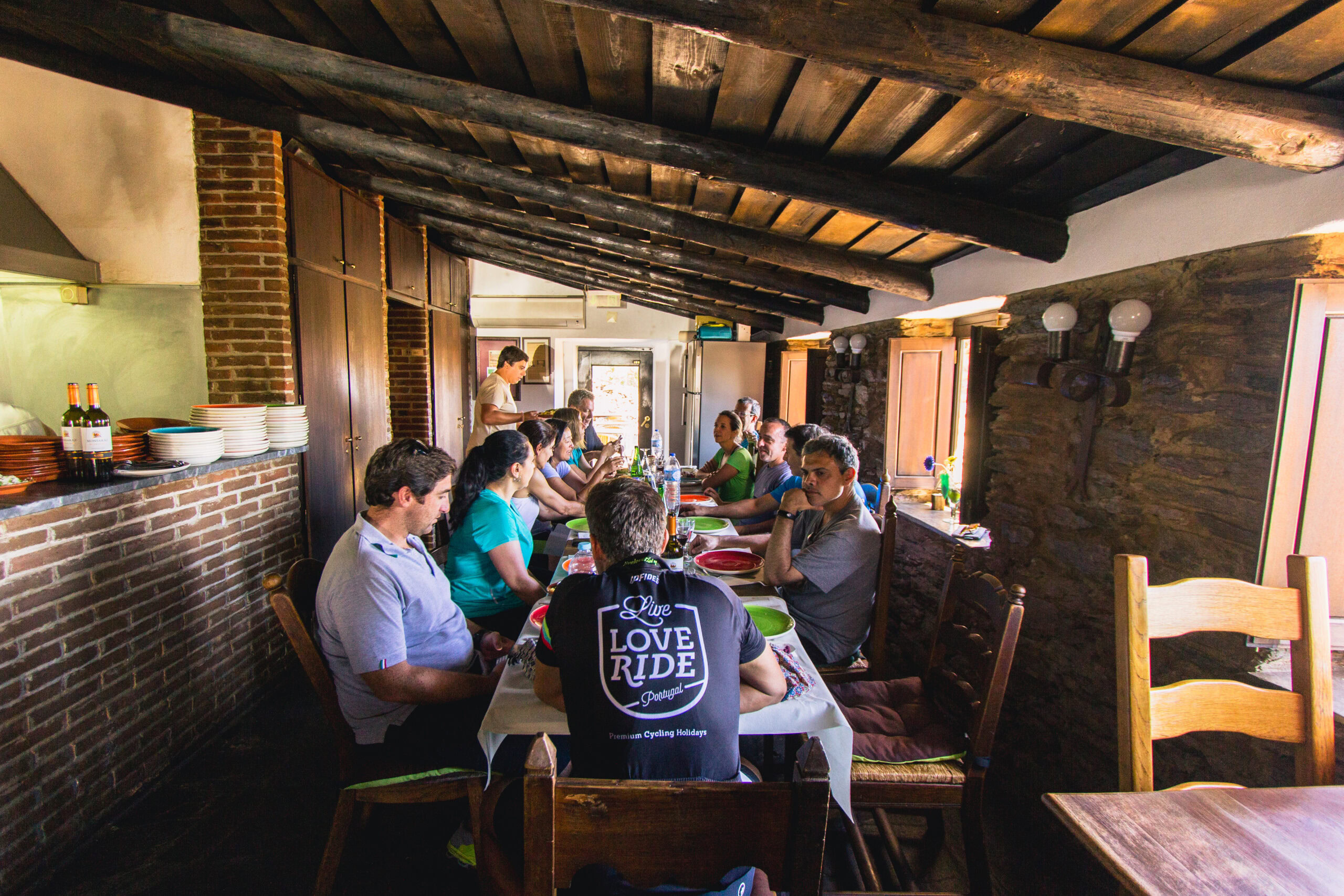
Alentejo cuisine is built around simple ingredients used exceptionally well. Bread, olive oil, pork, lamb, herbs, sheep cheese, tomatoes and seasonal vegetables form the basis of many traditional dishes.
Look for açorda alentejana, migas, porco preto, slow cooked lamb, regional cheeses and traditional desserts such as sericaia.
For cyclists, meals here are not simply fuel. They are part of the journey.
One restaurant we particularly enjoy is Sabores de Monsaraz, where traditional Alentejo cooking comes with wonderful views towards Lake Alqueva. It is exactly the kind of place where a planned lunch stop can easily become one of the highlights of the day.
Alentejo is one of Portugal’s great wine regions, with estates scattered between Estremoz, Borba, Reguengos de Monsaraz, Évora and many of the smaller towns in between.
Some estates are large and internationally known. Others are smaller producers where a tasting can feel much more personal. We enjoy combining both throughout a journey.
Near Évora, one of the producers we particularly recommend is Fitapreta, whose wines are produced at a historic estate just outside the city. It works particularly well as part of a cycling day through the countryside around Évora.
Other excellent names to explore include Cartuxa and Herdade do Esporão, while smaller estates throughout the region provide plenty of opportunities to discover wines you may never encounter outside Portugal.
Olive oil is equally important to the identity of Alentejo. Many estates produce both wine and olive oil, and a tasting often becomes an introduction to the agricultural traditions that have shaped this landscape for centuries.
Ride first and taste later. We prefer to incorporate a winery towards the end of a cycling day, when there is no need to get back on the bike for another serious stretch of road. A tasting followed by a long Alentejo lunch or early dinner is a much better finish.
São Pedro do Corval is considered Portugal’s largest pottery centre, with more than two dozen working potteries continuing a tradition closely connected to the local clay and agricultural life of the region.
Several workshops welcome visitors, and you can still watch experienced potters shaping the clay by hand at the wheel before pieces are painted and fired.
We love incorporating Corval into a cycling day because it gives you a reason to stop that has nothing to do with cycling. Put the bike aside, walk into a workshop, talk to the artisans and see a tradition that remains part of everyday life in the village.
The Lusitano horse is another important part of Alentejo identity.
The Coudelaria de Alter was founded in 1748 and remains one of the great centres of Lusitano horse breeding in Portugal. The estate covers around 800 hectares near Alter do Chão and offers visits that explore the horses, stables and history of the stud farm.
It makes an excellent cultural stop on a ride through northern Alentejo and introduces visitors to a tradition that is completely different from the wine, castles and medieval villages encountered elsewhere in the region.
Around Estremoz, Borba and Vila Viçosa, marble has shaped both the landscape and local identity for centuries.
You see it everywhere. In quarries cut deep into the countryside, but also in churches, fountains, pavements, doorways and ordinary houses.
The finest expression of that heritage is the Paço Ducal de Vila Viçosa, whose extraordinary marble façade stretches across the Terreiro do Paço. The palace became closely associated with the House of Braganza and today houses collections connected to Portugal’s royal history.
We recommend allowing enough time to actually visit the palace. Vila Viçosa is not somewhere we like using merely as a coffee stop between two cycling stages.
Lake Alqueva is not only beautiful during the day. The surrounding countryside has extremely low levels of light pollution and has become one of Europe’s best known destinations for stargazing.
For cyclists staying around Monsaraz or Mourão, this creates a wonderful rhythm to the end of a day. Ride into Monsaraz in the late afternoon, watch the sunset from the castle walls, enjoy dinner in the village and then step outside beneath the Alentejo night sky.
More than anything else, Alentejo is defined by its pace.
People take time over coffee. Lunch can easily become the centre of the afternoon. Villages are quiet. Roads are empty. Conversations are rarely rushed.
That rhythm fits cycling perfectly.
You ride enough to feel the journey, but not so much that every day becomes a physical test. There is room for a detour, a winery, a pottery workshop, a palace, a swim in Lake Alqueva or another hour around the table.
For many of our guests, that balance between great cycling and meaningful travel is exactly what makes Alentejo stand out.
Alentejo can be explored throughout much of the year, but for a cycling holiday there are two seasons we particularly recommend: spring and autumn.
Our favourite months are generally April, May, late September and October. The temperatures are usually much better suited to longer days on the bike, restaurants and wineries are open, and the countryside is either at its greenest or taking on the golden colours that most people associate with Alentejo.
Spring is perhaps the most beautiful time to cycle in Alentejo.
After the winter rains, the countryside is surprisingly green. Wildflowers appear along the roads, cork oak forests are full of colour and fields that will become completely golden later in the year are still lush.
March can be more unpredictable, with cooler mornings and a greater chance of rain, but by April the conditions are often excellent for cycling.
April and May are two of our favourite months in the region. Days are longer, temperatures are generally comfortable and the landscape can look completely different from the Alentejo visitors encounter during summer.
If your mental image of Alentejo is a dry, golden landscape, come in April. Guests are often surprised by just how green the region can be. Add the wildflowers, quiet roads and comfortable temperatures and this is probably Alentejo at its most beautiful.
June can still provide excellent cycling, particularly during the first half of the month, but temperatures begin to rise considerably inland.
The landscape also starts changing quickly. Green fields turn gold, the countryside becomes drier and Alentejo begins to take on its classic summer appearance.
If cycling in June, we prefer earlier starts. This allows you to enjoy the coolest part of the day on the bike and arrive at your destination in time for lunch, a swim or an afternoon exploring off the bike.
July and August are not the months we normally recommend for an inland Alentejo cycling holiday.
Temperatures can rise well above 35°C, particularly around Évora, Monsaraz and the open plains further south. There is also relatively little shade on many rural roads.
It is possible to ride with very early starts, but for most guests there are simply better times of year to experience the region.
The exception is the Southwest Alentejo and Vicentine Coast. The Atlantic has a strong moderating effect on temperatures, making coastal riding around Porto Covo, Vila Nova de Milfontes and further south considerably more attractive during summer than the interior.
Autumn is our other favourite season in Alentejo.
September can still be hot, especially during the first half of the month, but conditions generally become increasingly pleasant as the month progresses.
This is also harvest season. Vineyards are busy, grapes are being collected and wineries have an energy that you simply don’t experience at other times of year.
By October, temperatures are usually much more comfortable for cycling. The light becomes softer, the countryside takes on warmer colours and the roads remain wonderfully quiet.
For cyclists interested in combining riding with wine and gastronomy, late September and October are particularly special.
Spring and autumn offer two completely different versions of Alentejo. Choose April or May for green landscapes and wildflowers. Choose late September or October for golden countryside, vineyards and harvest season. We love both for different reasons.
Winter cycling in Alentejo is possible, but conditions are less predictable.
There can be beautiful sunny days with excellent riding temperatures, but also colder mornings, rain and shorter daylight hours. Northern Alentejo around Marvão and Serra de São Mamede can feel considerably colder than the southern plains or coast.
For experienced independent cyclists with flexible plans, winter can provide wonderfully empty roads and a very local experience. For a first cycling holiday in Alentejo, however, we would choose spring or autumn.
If we had to narrow it down, we would choose April, May, late September or October.
But the choice depends on what you want from the journey.
Choose April or May if you want green landscapes, wildflowers, comfortable riding temperatures and long spring days.
Choose late September or October if you want warmer colours, wine harvest, beautiful light and the food and wine culture of Alentejo at its most atmospheric.
Either way, these seasons allow you to enjoy what we think Alentejo does better than almost anywhere else: a rewarding day on the bike with enough time and energy left to enjoy everything that comes after it.
For most cycling journeys through Alentejo, our first choice is simple: a road bike.
The region has an exceptional network of paved secondary roads connecting historic towns, vineyards, cork forests and small rural villages. Traffic is often remarkably light, the surfaces are generally good and the terrain tends to roll rather than climb continuously.
That combination makes Alentejo particularly enjoyable on a road bike. You can cover enough distance to see the landscape change throughout the day without feeling that the objective is simply to accumulate kilometres or elevation.
If your journey takes you through places such as Marvão, Castelo de Vide, Crato, Estremoz, Vila Viçosa, Monsaraz and Évora, we would normally recommend a road bike tour.
The northern part of the region provides the biggest climbs, particularly around Serra de São Mamede and Marvão. Further south, the terrain generally becomes more flowing, with long rolling roads through vineyards, olive groves and cork oak forests.
There are still plenty of short climbs. Many of Alentejo’s most beautiful towns were deliberately built on hilltops, after all. But compared with a destination such as the Douro Valley, the riding is considerably less demanding.
Don’t underestimate Alentejo just because it isn’t mountainous. Rolling terrain adds up over a full day, especially when there is wind. But that’s part of what we like about riding here. You finish feeling that you’ve had a proper day on the bike without necessarily arriving with tired legs and nothing left for the rest of the experience.
There are two areas where we particularly enjoy leaving the road bike behind: the Guadiana Valley and the Southwest Alentejo and Vicentine Coast.
Around the Guadiana Valley Natural Park, gravel bikes give us access to rural tracks, farm roads and remote landscapes that would otherwise be difficult to incorporate into a cycling journey. The riding is generally about exploration rather than technical difficulty.
On the Southwest Coast, gravel is equally useful. The area around the Rota Vicentina contains a mixture of quiet roads, agricultural tracks and unpaved routes running through cork forests and towards the Atlantic.
A gravel bike allows you to move naturally between these surfaces and reach beaches, cliffs and small coastal villages without being restricted to the paved road network.
We don’t recommend blindly following hiking trails such as the Fishermen’s Trail by bike. Instead, we select rideable gravel tracks and quiet roads that preserve the coastal experience while making sense on two wheels.
For us, gravel in Alentejo isn’t about finding the most technical trail. It’s about access. A gravel bike lets you turn down that small farm road, cross a cork forest or follow a track towards the Guadiana or Atlantic and discover a side of the region most visitors never see.
E bike tours work exceptionally well in Alentejo.
They are particularly useful for couples and groups where riders have different fitness levels, allowing everyone to share the same route and experience without having to ride at exactly the same physical level.
They also take the sting out of some of the region’s more memorable climbs. The final ascent into Monsaraz, the roads around Marvão and Serra de São Mamede, or a longer rolling day through central Alentejo become much more accessible with electric assistance.
Importantly, an E bike doesn’t change what makes Alentejo special.
You still ride the same quiet roads, feel the landscape changing around you and arrive at the same villages, wineries and restaurants. You simply have the option of adding assistance when the road points upwards or the kilometres begin to accumulate.
For many of our guests, that means riding further, staying together and finishing the day with enough energy to enjoy everything that happens away from the bike.
If we were choosing purely by region, we would keep it simple:
Classic inland Alentejo: Road bike.
Marvão and Serra de São Mamede: Road bike or E bike if you want assistance on the climbs.
Évora and the surrounding countryside: Road bike for the classic routes, or gravel if you want to explore tracks towards Almendres and the cork oak countryside.
Guadiana Valley: Gravel bike.
Southwest Alentejo and Vicentine Coast: Gravel bike.
Mixed ability groups: Road bikes and E bikes work extremely well together on most of our inland routes.
Ultimately, Alentejo doesn’t require a specialist bike. That’s another part of its appeal. For most riders, a good road bike and a willingness to slow down occasionally are all you need.
After years of riding Alentejo, we’ve learned that there isn’t one route that can show you everything.
The mountainous north around Marvão feels completely different from the vineyards and marble country around Estremoz. Lake Alqueva has its own rhythm. The Guadiana is wilder and more remote. And once you reach the Atlantic, Alentejo changes again.
That’s why our cycling journeys through the region follow very different routes.
If you want to understand the classic Alentejo by bike, this is our favourite journey.
Our Heritage and Wine Country bike tour starts with a transfer from Lisbon all the way to Marvão, high in the Serra de São Mamede and close to the Spanish border. From there, you essentially ride south through the history and landscapes of inland Alentejo.
The first riding day immediately shows you why we love this route. You leave Marvão through the rugged countryside around Beirã, stop in Castelo de Vide, then continue through olive groves and cork oak forests towards Flor da Rosa, Crato and Alter do Chão, home of the Lusitano horse.
From Crato, the landscape begins to open. You ride the rolling roads of northern Alentejo towards Estremoz and the Serra d’Ossa, before crossing the mountain range on the way to Redondo and Monsaraz.
That arrival is one of our favourite moments of the whole tour. After a day on the bike, Monsaraz appears above Lake Alqueva, sitting on its fortified hilltop. Stay nearby, walk up to the castle in the late afternoon and watch the sun disappear over the Alentejo plains.
The following ride takes you through Reguengos de Monsaraz, home of Herdade do Esporão, before following some of the quietest roads we know through Montoito, vineyards and farmland towards Évora.
We finish with an optional loop towards Arraiolos, riding through cork and olive country before returning to Évora, where we think the bicycle should finally be parked and the city explored on foot.
It is a proper point to point cycling journey, but the objective is never simply to cover distance. The stages generally sit between 55 and 75 kilometres, with enough climbing to make them interesting and enough time left for castles, wine, food and the places you are riding through.
Choose this tour if: you want to cross classic inland Alentejo rather than stay in one area, enjoy road cycling and want the strongest combination of riding, history, wine and changing landscapes.
Not everyone wants to change hotel almost every day or ride 60 to 80 kilometres to reach the next destination.
Our Alentejo Wine Country bike tour takes a different approach. Instead of crossing the region from north to south, it uses Évora, Monsaraz and Vila Viçosa as bases and gives you a series of rides and optional loops from each one.
You begin in Évora, where you can ride towards Arraiolos or take the shorter excursion towards the prehistoric Almendres Cromlech, returning in time for a late afternoon tasting at Cartuxa.
Then comes one of our favourite road days: Évora to Monsaraz through Montoito and Reguengos, riding through vineyards and farmland towards Lake Alqueva.
From Monsaraz, you don’t have to pack your bags the following morning. Instead, you can ride a loop towards Herdade do Esporão, taste the wines, return to the hotel and walk up to Monsaraz for sunset.
The journey then continues north to Vila Viçosa, following Alentejo backroads beside Lake Alqueva and through the marble country. From Vila Viçosa, another optional ride takes you through Borba to Estremoz, with the choice of returning on the quieter backroads or adding the climb and descent of the Serra d’Ossa.
This is Alentejo with more room around the cycling. Daily rides generally range from around 30 to 60 kilometres, and several are optional. If one morning you’d rather stay at the hotel, visit a palace or spend longer over lunch, you can.
Choose this tour if: you want easier riding, fewer hotel changes and more time for wineries, historic towns, restaurants and relaxing between rides.
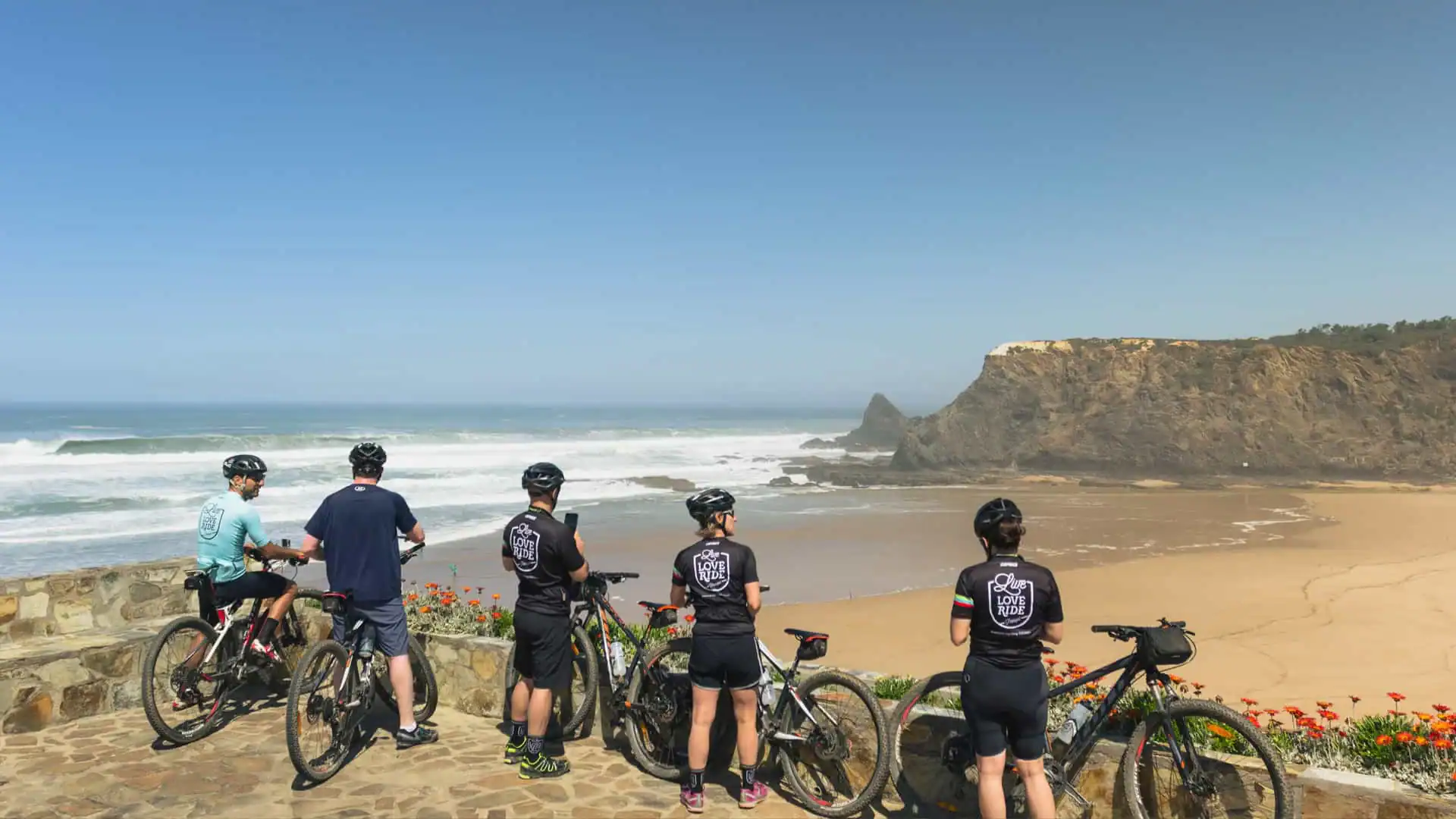
For a completely different side of the region, our Southwest Coast bike tour starts in Vila Nova de Milfontes and follows the protected coastline south through the Vicentine Coast and into the Algarve.
This is not simply a road tour beside the sea.
From Cercal, you leave the paved road for macadam tracks through the agricultural landscape before reaching Almograve. From there, one of our favourite sections follows the coastline towards Cabo Sardão, with the Atlantic below the cliffs and seabirds overhead.
The following day takes you through Zambujeira do Mar, Praia do Carvalhal and Odeceixe, repeatedly dropping towards the ocean and climbing back onto the coastal plateau.
Once in the Algarve, the route becomes even more varied. From Aljezur, you climb past the castle before joining a long macadam road through the natural park towards Carrapateira. The coastal circuit here is spectacular, with enormous views over the cliffs and Atlantic.
From the tiny restored village of Pedralva, the journey continues towards Cape São Vicente and Sagres, reaching the cape itself on macadam before finishing the following day in Lagos via the beaches around Praia da Luz.
This is the Alentejo for riders who want the ocean to be part of the journey. The stages are shorter, generally around 35 to 50 kilometres, but the mixture of macadam, coastal tracks, steep little valleys and paved roads keeps the riding interesting.
Choose this tour if: you want wild Atlantic scene
ry, mixed surfaces, fishing villages, beaches and a journey that connects coastal Alentejo with the Algarve.
And then there is our wildest Alentejo journey.
Our gravel journey from the Guadiana to the Algarve begins at a wine estate near Albernoa, deep in southern Alentejo, and immediately heads away from the classic tourism routes.
The first ride takes you through the Guadiana Valley Natural Park towards Mértola, following gravel tracks through the montado landscape of cork oak and olive trees before finishing beneath Mértola’s castle overlooking the Guadiana.
The next day is one of the most unusual rides we operate anywhere in Portugal.
You leave Mértola on backroads and gravel towards the abandoned Minas de São Domingos, where the remains of the old mining complex create an almost surreal landscape. From there, you descend towards Pomarão on the Guadiana.
But instead of simply following the Portuguese side south, you cross into Spain.
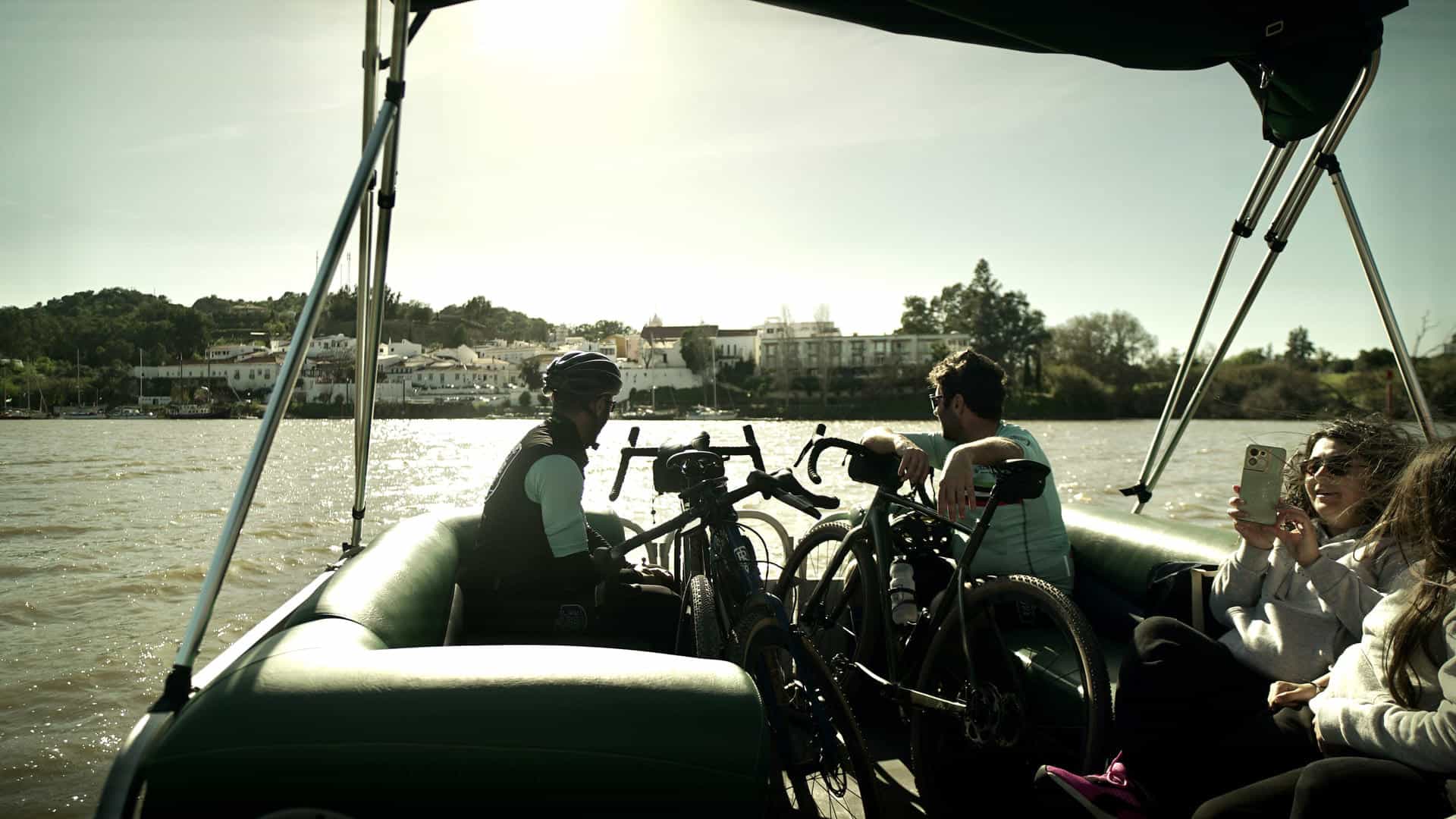
An old railway line, now converted into a Via Verde, takes you towards Sanlúcar de Guadiana. There, you cross the river by boat into Alcoutim, following a frontier once used by smugglers moving between Portugal and Spain.
From Alcoutim, the journey follows the predominantly gravel GR15 south along the Guadiana towards Castro Marim. Then the landscape changes again. The river gives way to the Atlantic, and coastal trails take you through Cacela Velha towards Tavira.
The final rides explore the Ria Formosa towards Barril, Fuseta and Olhão, and the inland Barrocal, where gravel trails weave between olive groves, citrus orchards and rolling hills before descending again towards Tavira.
This isn’t gravel for the sake of gravel. The unpaved roads are what allow the journey to connect places that would otherwise make little sense together: wine country, the Guadiana Natural Park, Mértola, abandoned mines, an old smuggling frontier, Spain, the eastern Algarve and finally the Atlantic.
Choose this tour if: you want the most adventurous ride of the four, enjoy gravel and mixed surfaces, and would rather discover remote landscapes than follow the classic
Alentejo highlights.
Yes. Alentejo is one of our favourite cycling regions in Portugal because it combines quiet roads, beautiful landscapes, historic towns, excellent food and wine, and terrain that is rewarding without being excessively demanding.
We’ve been running tours here since 2014, and it is particularly good for cyclists who want the bike to be an important part of the holiday, but not the only part of it.
Expect long stretches of quiet country road through cork oak forests, vineyards, olive groves and open farmland, connected by whitewashed villages, castles and historic towns.
Most inland riding is on paved secondary roads. The terrain is predominantly rolling, although northern Alentejo around Marvão and Serra de São Mamede is considerably hillier.
On the Southwest Coast and around the Guadiana, there are excellent opportunities to leave the asphalt and explore by gravel bike.
For most recreational cyclists, Alentejo is a moderate cycling destination.
It is not flat, and the rolling terrain can accumulate a surprising amount of elevation over a full day, but you won’t encounter the continuous steep climbing associated with regions such as the Douro.
The hardest riding is generally around Marvão and Serra de São Mamede. The Serra d’Ossa also provides a proper climb for riders looking for more of a challenge.
Further south, the terrain becomes gentler, although many of the most beautiful villages, including Monsaraz, were built on hilltops for a reason.
Yes, provided you choose the right route and daily distances.
The quieter roads and generally manageable terrain make Alentejo a very good choice for less experienced cyclists. An itinerary based around Évora, Monsaraz and Vila Viçosa can be designed with shorter riding days and plenty of time away from the bike.
Beginners may prefer to avoid the more demanding roads around Serra de São Mamede, or use an E bike for additional assistance.
Absolutely. Strong cyclists can easily build longer days of 80 to 120 kilometres using the region’s extensive network of secondary roads.
Northern Alentejo provides more climbing, while Serra d’Ossa can be incorporated into a road itinerary for an additional challenge.
What Alentejo does not offer is endless mountain passes. Experienced riders who come here tend to enjoy it for the quality and emptiness of the roads, the landscapes and the freedom to cover significant distances without constantly dealing with traffic.
For most visitors, we think 40 to 70 kilometres per day is the sweet spot.
You can certainly ride further, but Alentejo rewards leaving space in the day. A 50 kilometre ride followed by a winery visit, a long lunch and a walk through a medieval village can be a much better Alentejo experience than riding 100 kilometres simply because your legs allow it.
Our favourite periods are April and May, and late September through October.
Spring is green, full of wildflowers and very different from the dry Alentejo landscape many visitors imagine. Autumn brings warmer colours, beautiful light and the wine harvest.
March, June and November can also work well, depending on the weather and the part of Alentejo you are visiting.
You can, but we generally do not recommend July and August for a multi day cycling holiday in inland Alentejo. Temperatures can become extremely high and many of the rural roads offer limited shade.
The Southwest Alentejo and Vicentine Coast is different. The Atlantic moderates temperatures, making coastal cycling much more attractive during summer than riding around Évora or Lake Alqueva.
Both are excellent, but they feel very different.
Choose April or May for green landscapes, wildflowers and mild temperatures.
Choose late September or October for golden landscapes, harvest season, vineyards and beautiful autumn light.
If we had to choose only one period, it would probably come down to whether you want to see green Alentejo or golden Alentejo.
For classic inland Alentejo, we generally recommend a road bike.
The region’s network of paved secondary roads is excellent, and a road bike is ideal for connecting places such as Marvão, Crato, Estremoz, Vila Viçosa, Monsaraz and Évora.
For the Southwest Coast and the Guadiana Valley, we prefer a gravel bike because it opens up agricultural tracks, rural paths and mixed surface routes that are difficult to explore properly on a conventional road bike.
Yes. Alentejo is particularly well suited to E bikes.
They allow couples or groups with different fitness levels to ride together and make the hillier sections around Marvão, Serra de São Mamede and Monsaraz considerably more accessible.
An E bike also allows you to enjoy longer stages without arriving too tired to explore the towns, wineries and restaurants along the way.
Yes, although we wouldn’t choose gravel simply for the sake of avoiding asphalt.
In classic inland Alentejo, the paved roads are often so quiet and enjoyable that a road bike makes more sense.
Gravel becomes particularly interesting around the Guadiana Valley Natural Park, where rural tracks allow you to explore remote countryside around Mértola, and on the Southwest Coast, where gravel and agricultural roads connect the protected landscapes of the Vicentine Coast.
Yes, but a cycling route should not simply copy the walking trail.
Some sections of the Rota Vicentina, particularly the Fishermen’s Trail, are designed specifically for walkers and can be sandy, narrow or unsuitable for bicycles.
We prefer combining suitable gravel tracks, agricultural roads and quiet paved roads through the same landscape. You still experience the cliffs, beaches, fishing villages and wild Atlantic scenery without forcing a bicycle onto trails where it does not belong.
One of Alentejo’s biggest advantages is its low population density and extensive network of quiet secondary roads.
Many of our favourite roads have remarkably little traffic. However, route choice matters. We recommend avoiding the larger national roads wherever a good secondary road alternative exists.
The shortest driving route between two towns is not necessarily the best cycling route, which is one of the reasons local route knowledge makes such a difference here.
For a first trip, some of our favourite areas include Marvão and Serra de São Mamede, Crato and Alter do Chão, Estremoz and Serra d’Ossa, Vila Viçosa, Monsaraz and Lake Alqueva, Évora and Arraiolos.
For something wilder, explore the Guadiana Valley around Mértola by gravel bike or head to the Southwest Alentejo and Vicentine Coast for Atlantic riding.
For a point to point journey through classic Alentejo, we love starting in Marvão in the north and gradually travelling south towards Estremoz, Monsaraz and Évora.
If you prefer shorter rides from a few bases, Évora, Monsaraz and Vila Viçosa work particularly well.
For coastal cycling, start around Vila Nova de Milfontes. For a gravel journey through the Guadiana, the countryside around Albernoa and Mértola provides an excellent starting point.
We recommend 5 to 7 days for most cycling holidays.
A week is enough to experience several landscapes and historic towns without turning the journey into a race between hotels.
If you have fewer days, choose a smaller area rather than trying to cross the entire region. Évora, Monsaraz and Vila Viçosa make an excellent combination for a shorter trip.
Yes, and there are two particularly interesting ways to do it.
On the west coast, you can follow the protected landscapes of the Southwest Alentejo and Vicentine Coast through Vila Nova de Milfontes, Zambujeira do Mar and Odeceixe before continuing into the Algarve towards Aljezur, Carrapateira, Cape São Vicente, Sagres and Lagos.
Further east, gravel riders can follow the Guadiana south through Mértola and Alcoutim before reaching Castro Marim, Tavira and the Ria Formosa.
Both journeys connect Alentejo and Algarve, but they could hardly feel more different.
Absolutely. Wine is one of the great pleasures of cycling through inland Alentejo.
Areas around Estremoz, Évora and Reguengos de Monsaraz contain some of the region’s most interesting producers, including Fitapreta, Cartuxa and Herdade do Esporão.
We prefer scheduling tastings towards the end of the riding day. That way you can actually enjoy the wines rather than worrying about another 30 kilometres afterwards.
Look for traditional dishes such as açorda alentejana, migas, porco preto, lamb dishes, local sheep cheeses and anything making good use of Alentejo olive oil and bread.
Near the coast, the cuisine changes and fresh fish and seafood become increasingly important.
And don’t plan every lunch as a quick cycling stop. In Alentejo, sitting around the table for longer than expected is part of the experience.
Very much so.
The rolling terrain and availability of E bikes make Alentejo one of the regions we particularly like for couples and groups where not everyone rides at the same level.
Stronger riders can use road bikes and add optional distance or climbing, while other members of the group can use E bikes and still share the same core route and experiences.
Choose self guided if you enjoy independence and want to control the rhythm of every day. With the routes, hotels, luggage transfers, navigation and support organised in advance, Alentejo is a wonderful place to ride independently.
Choose guided if you want more context and support throughout the journey. A local guide can introduce you to the stories, people, food, wineries and small places you might otherwise pass without noticing.
We’ve been running bike tours in Portugal since 2014, and two members of our team were born and raised in Alentejo. That local knowledge has shaped the routes and experiences we use here today.
They are two of Portugal’s great cycling regions, but they offer very different experiences.
The Douro Valley is more dramatic and more demanding. Expect steeper climbs, deep river valleys and terraced vineyards.
Alentejo is more open and generally gentler. The roads roll through enormous landscapes and the cycling leaves more space in the day for castles, wineries, villages and long meals.
If you want climbing and dramatic terrain, choose the Douro. If you want a balance of great cycling, culture, food and wine without every day being too heavy on the legs, choose Alentejo.
For a first journey through classic inland Alentejo, our Heritage and Wine Country route gives you the most complete point to point experience, connecting the north around Marvão with Estremoz, Monsaraz and Évora.
For shorter riding days and more time for wine, culture and relaxing, our Alentejo Wine Country journey focuses on Évora, Monsaraz and Vila Viçosa.
Choose the Southwest Coast if you want the Atlantic, beaches and mixed surface riding through the Vicentine Coast towards the Algarve.
And choose our Guadiana gravel journey if you want the most adventurous option, riding through remote southern Alentejo, Mértola, the Spanish borderlands and eventually into the eastern Algarve.
You can compare all of them on our Alentejo bike tours page.
We’ve been running cycling tours in Alentejo since 2014, and somehow the region still finds ways to surprise us.
Part of that connection is personal. Two members of our team were born and raised here, and that unmistakable Alentejo character has become part of the way we experience and share the region with our guests.
But mostly, we keep coming back because Alentejo gets the balance right.
The roads are good enough to make you excited about the day’s ride, but the cycling rarely overwhelms everything else. There is time to climb to a castle, meet a winemaker, watch a potter at work, swim in Lake Alqueva, discover a tiny village restaurant or simply sit somewhere with a coffee and wonder why there are so few people on these roads.
Some days take you through vineyards and cork oak forests. Others climb into the Serra de São Mamede, follow the Guadiana through remote southern Alentejo or reach the wild Atlantic landscapes of the Vicentine Coast.
That’s the Alentejo we’ve come to know after more than a decade of riding here, and the one we try to share through our journeys.
If you’re ready to experience it for yourself, explore our Alentejo bike tours, or discover our complete collection of bike tours in Portugal.
Come for the cycling. Take your time with everything else.