
The Algarve, the southernmost region of continental Portugal, is a destination renowned for its beaches, cliffs and sunny weather. Cycling Algarve is a great way to explore the best of this beautiful region, as well as getting to know the countryside and exploring its car-free roads and trails. Fit for beginners or expert riders, there are plenty of options to go Cycling in Algarve – here are some of them!
The Algarve is Portugal’s southernmost region, and the most popular touristic destination in the country – almost 10 million people visit it every year, especially during peak season. The Algarve extends just south of the Tagus valley to the southern coast of the Iberian Peninsula. Its highest point is Fóia, at 902 metres, in the mountain range of Monchique. It is also the home of the Ria Formosa lagoon, a nature reserve of over 170 square kilometres and a stopping place for hundreds of different birds. The length of the south-facing coastline is approximately 155 kilometres. The coastline is notable for picturesque limestone caves and grottoes, particularly around Lagos. It is also home to a big variety of beaches, from small and quiet beaches of the Vicentina Natural Park (from Aljezur to Sagres) to big, sandy extensions in Alvor ou Falésia. The temperatures fluctuate between 25 °C and 48 °C (118 °F) in the summer.
The combination of these attributes makes it a great destination for cycling, especially in the off-peak season, as the weather is sunny and nice all year long. It’s also a great destination in the pre-season for road cyclists that flee their colder and wetter countries to join Algarve Cycling Camps from January to May, where they explore the inner roads of the Algarve, climbing to the top of the “Monchique mountain range”, “Barranco do Velho”, etc.
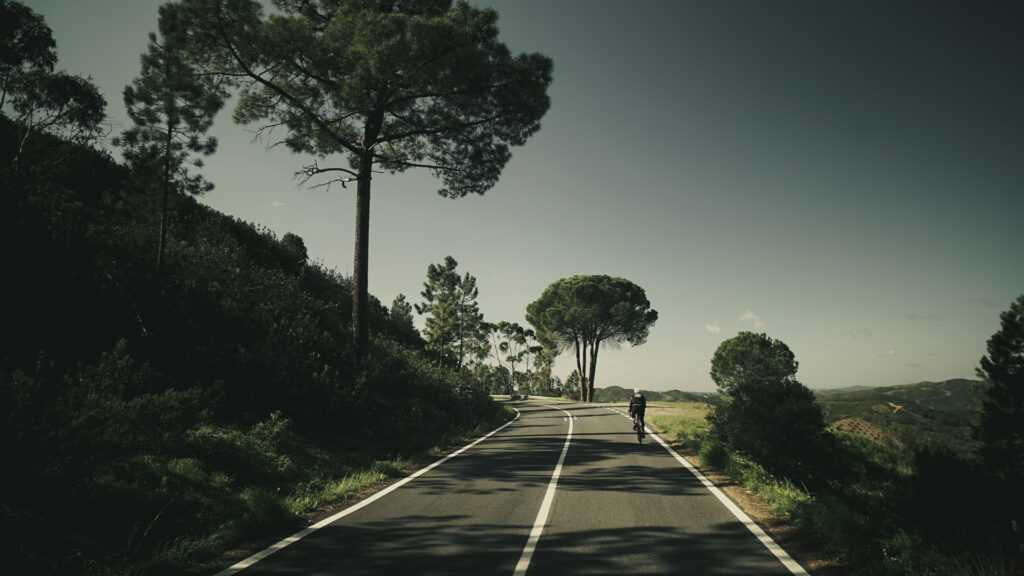
It is also a great destination for gravel enthusiasts, as there is a great combination of back roads and trails to explore, especially in the inland Barrocal area, between the coast and Alentejo. You can connect Alentejo’s Guiadiana Natural Park to Minas de São Domingos and the identified trail GR15 to descend towards the Algarve coast for an amazing gravel route for instance:
Check out our video below from our gravel bike tour in Algarve, that connects the Guadiana Natural park in Alentejo to the Algarve coastline:
Another popular route for bike touring and experienced cyclists is the Via Algarviana, a long distance path (300km long), perfect for hiking and biking, that runs from Alcoutim, in the Eastern Algarve, all the way across the region to the western tip at Cape St. Vincent, near Sagres and crossing the Costa Vicentina Natural Park. It follows a meandering, rural route through the Serra do Caldeirão and Serra de Monchique. The Eurovelo1 route also makes up for a soft riding experience, by the coast line from East to West (Vila Real de Santo António to Sagres), fit for beginner cyclists or for bike touring, you can ride the whole route or just a parts, depending on where you are staying.
Mountain bikers and bike touring enthusiasts can also explore the Vicentina Natural Park, following the Rota Vicentina from Aljezur towards Sagres, exploring the untouched beaches of Arrifana, Bordeira, Carrapateira, the less touristic side to this region. Mountain bikers will love to explore the Monchique mountain range and its trails, perfect for cross country, freeride or even downhill.
Cycling Algarve is a great option for visiting the region as it is an alternative that will allow you to explore the culture and history of the region, deeply – cycling tourism provides an immersive way to get to know the people, food and culture. You also choose to join a bike tour in Algarve and join a group or private tour to explore the region with local guides.
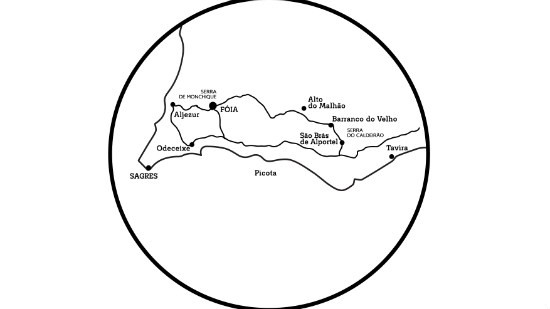
The Algarve may look relatively small on a map, but the cycling changes enormously depending on where you ride.
The eastern Algarve is flatter and better suited to recreational cycling. The roads become progressively more rolling as you travel west, while the interior introduces proper climbing. Beyond Lagos and towards Sagres, Aljezur and Odeceixe, the landscape becomes wilder and increasingly suited to gravel and adventure riding.
For that reason, we don’t think there is one “best” place to cycle in the Algarve.
There is a best area for the kind of cyclist you are.
If you’re looking for easier cycling in the Algarve, start in the east.
The landscape surrounding Tavira, Cacela Velha, Castro Marim and Vila Real de Santo António is noticeably flatter than the western Algarve, making this our preferred area for recreational cyclists, touring bikes and e-bikes.
The Ria Formosa Natural Park defines much of the landscape here, with a vast system of lagoons, salt marshes, barrier islands and channels stretching along the eastern Algarve.
Rather than chasing climbs, cycling here is about moving slowly through the landscape.
Quiet roads and cycling paths connect historic towns, fishing communities, salt pans and the coastline, while Tavira makes an excellent stop for exploring one of the Algarve’s most attractive historic centres.
Further east, Vila Real de Santo António sits beside the Guadiana River and the Spanish border – the entry point on the Eurovelo1 route from Spain . From here, it’s possible to begin a longer journey westwards across the Algarve or simply explore the flatter roads surrounding Castro Marim and the eastern coast.
Best for: Recreational cyclists, couples, touring and relaxed cycling
Best bike: Touring bike or e-bike
Difficulty: Easy to moderate
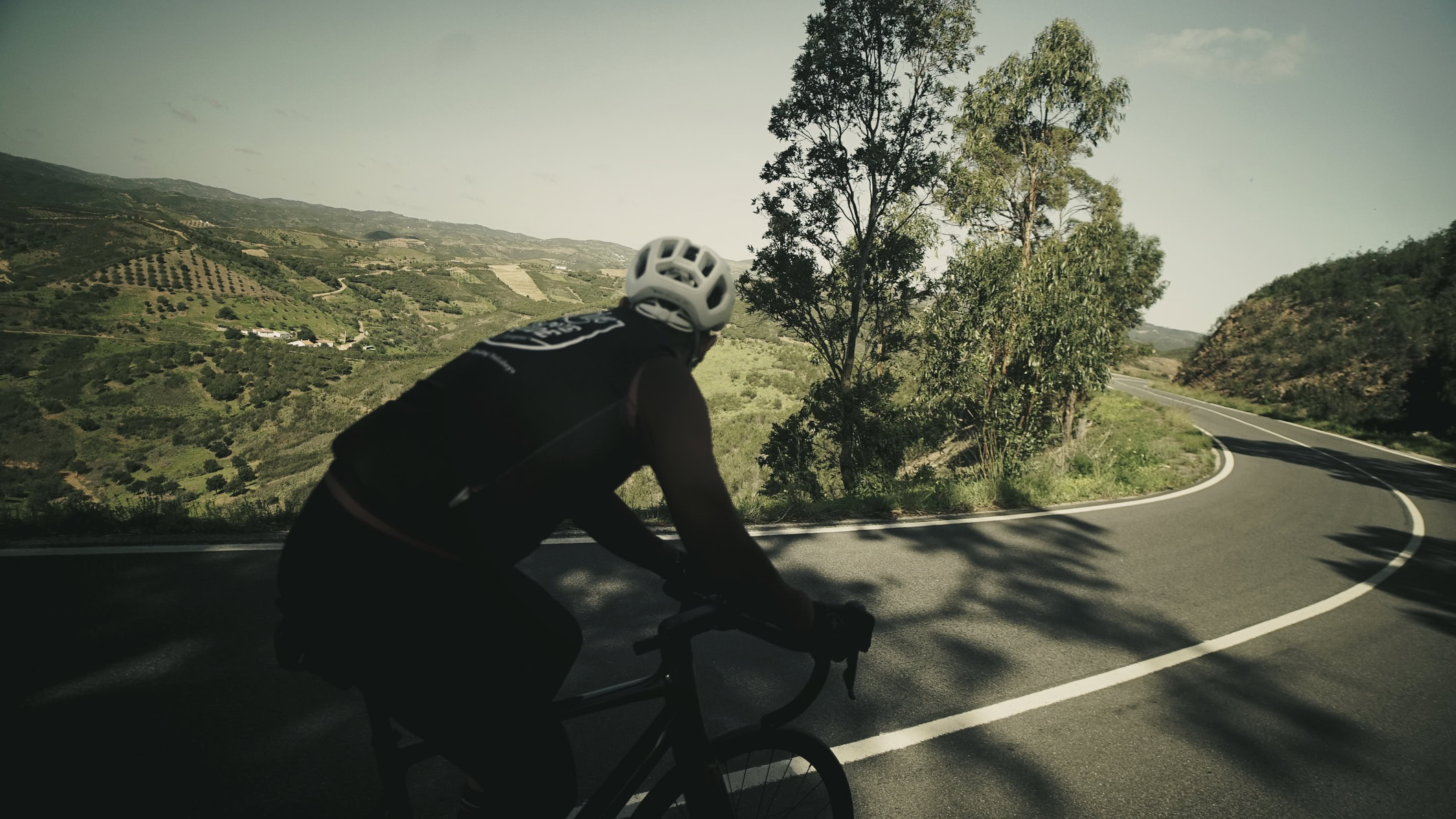
For road cyclists, we generally prefer the western Algarve, and Lagos makes an excellent base from which to explore it.
The terrain immediately becomes more interesting.
Ride west and you can follow rolling roads towards Vila do Bispo, Sagres and Cape St. Vincent. Turn inland and the roads lead towards Barão de São João, Bensafrim and eventually the Serra de Monchique.
That gives you an enormous variety of riding without needing to change hotels every night.
One day can be a relatively fast coastal ride towards Sagres. The next can take you deep into the hills for a serious climbing day. Recovery rides can stay closer to Lagos, while longer routes can connect the western coast with the Algarve interior.
Lagos itself also works particularly well as a cycling base because there’s plenty to enjoy when you’re off the bike: beaches, the cliffs and rock formations around Ponta da Piedade, a lively historic centre and a good selection of restaurants and hotels.
It’s why we chose Lagos as the base for our Algarve road cycling retreat.
Best for: Road cyclists, training escapes and riders who enjoy climbing
Best bike: Road bike or e-road bike
Difficulty: Moderate to challenging
If you’re looking for serious road cycling in the Algarve, head inland.
The Serra de Monchique rises dramatically above the surrounding landscape and provides some of the region’s most rewarding road cycling.
The obvious objective is Fóia, the highest point in the Algarve at just over 900 metres above sea level.
But we wouldn’t look at Fóia as an isolated climb.
The real pleasure is designing a full day around it, using the quieter roads through the hills to approach Monchique before climbing towards the summit. Depending on your starting point and route, this can become a substantial day with plenty of elevation.
From Lagos, it’s possible to create excellent loops into the Monchique hills, while stronger cyclists can combine Fóia with roads towards Marmelete, Alferce, Odelouca or Silves.
The old roads through this part of the Algarve are far removed from the busy coastal resort areas. You’ll ride through forest, small villages and constantly changing terrain, with long climbs followed by rewarding descents.
For experienced cyclists, this is one of the areas that completely changes the perception that the Algarve is simply a flat beach destination.
Best for: Experienced road cyclists and climbers
Best bike: Road bike or e-road bike
Difficulty: Challenging
Few rides in the Algarve have a stronger sense of destination than riding towards Sagres and Cape St. Vincent.
As you approach Portugal’s southwestern corner, the landscape becomes increasingly open and exposed. Trees disappear, the Atlantic begins to dominate the horizon and enormous cliffs fall towards the ocean.
The cycling itself isn’t necessarily the hardest in the Algarve, but wind can completely change the character of a ride here.
From Lagos, road cyclists can make Sagres the objective of a longer ride through the western Algarve. For touring and gravel riders travelling across the region, it also makes a natural milestone before turning north towards the Costa Vicentina.
Continue another few kilometres beyond Sagres and you reach Cape St. Vincent, with its lighthouse standing above the cliffs at the southwestern extremity of Portugal.
It’s one of those places where the destination adds something to the ride.
You haven’t simply completed another cycling route.
You’ve ridden to the edge of the continent.
Best for: Road, touring and gravel cyclists
Best bike: Road, gravel, touring or e-bike
Difficulty: Moderate, but potentially demanding in strong winds
North of Sagres, the Algarve changes again.
The Costa Vicentina is the Algarve at its wildest: enormous Atlantic beaches, high cliffs, small villages and large areas of protected landscape stretching north towards Aljezur, Odeceixe and eventually into the Alentejo.
This is one of our favourite areas in Portugal for gravel and adventure cycling.
The roads themselves can be beautiful, but a gravel bike opens up many more possibilities. Rural tracks and dedicated cycling routes allow you to move between the coast and the countryside and reach places that simply aren’t accessible on a conventional road bike.
The Rota Vicentina has developed an extensive network specifically for cyclists, including gravel and mountain bike routes as well as longer-distance touring options.
It’s important, however, not to confuse these with the famous Fishermen’s Trail. That spectacular trail follows the cliffs and beaches of the Southwest Coast but is designed exclusively for walkers. Cyclists should use the dedicated Rota Vicentina cycling network and suitable roads and tracks instead.
Aljezur makes a natural hub for exploring this landscape, with routes towards beaches such as Arrifana and Monte Clérigo and connections south towards Carrapateira and Sagres.
Further north, Odeceixe marks the transition between the Algarve and Alentejo and is one of our favourite places to continue a longer journey along Portugal’s Southwest Coast.
This is a very different Algarve from the resort towns of the south coast.
And for many cyclists, that’s precisely the attraction.
Best for: Gravel riders, mountain bikers and adventure cyclists
Best bike: Gravel or mountain bike
Difficulty: Moderate to challenging depending on the trails
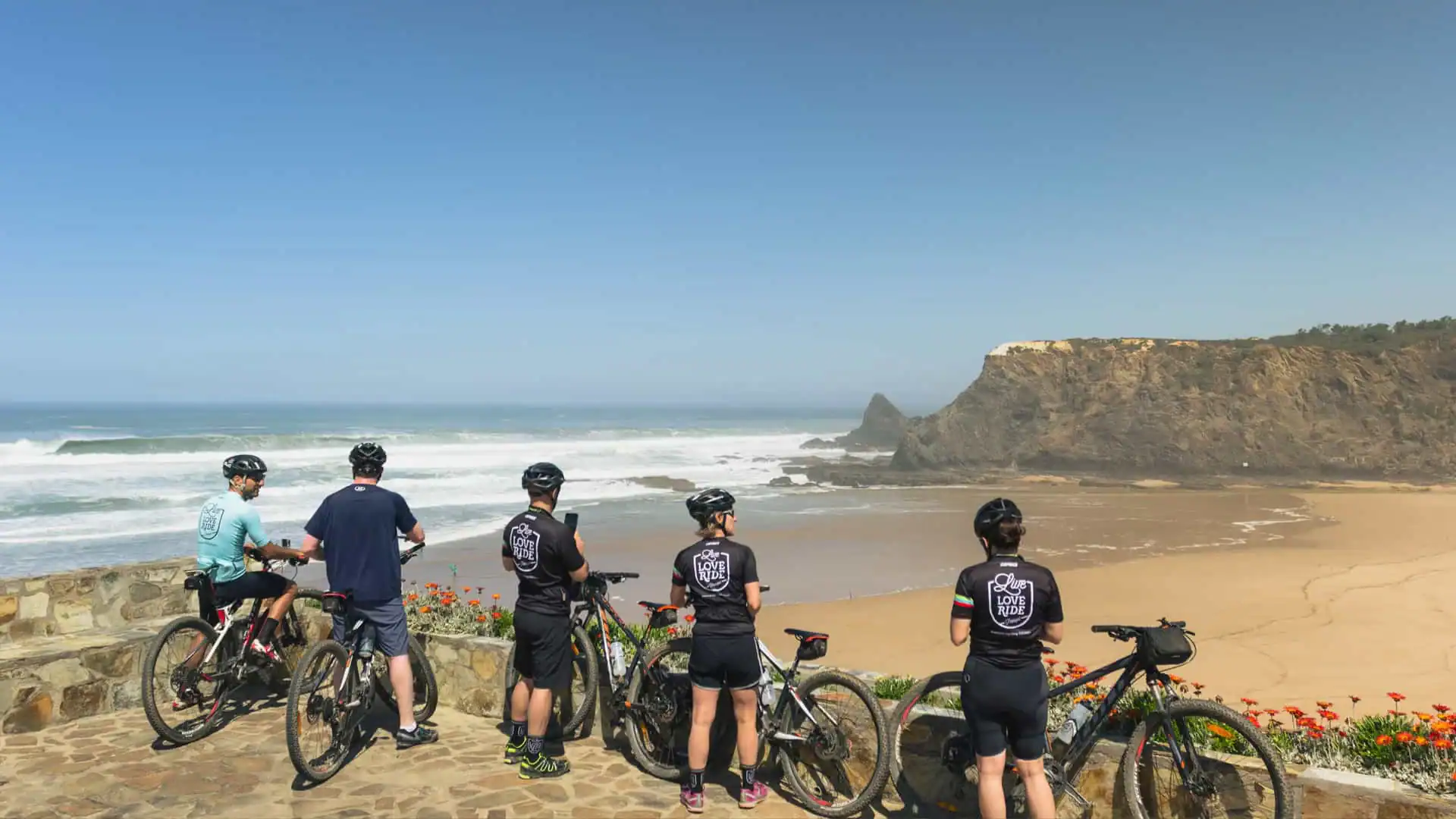
The Algarve’s interior deserves mentioning, but it also requires some caution.
Long-distance routes such as the Via Algarviana (GR13) cross roughly 300 km of the Algarve interior between Alcoutim, near the Spanish border, and Cape St. Vincent, travelling through the Serra do Caldeirão and Serra de Monchique.
The landscape is spectacularly different from the coast: remote villages, cork forests, mountain terrain and very little of the development associated with the southern Algarve.
But don’t assume that because a route appears on a map it makes for easy bicycle touring.
Many of the Algarve’s GR trails are physically demanding and can include rough, steep or technical terrain. They are much better suited to experienced mountain bikers than recreational cyclists.
For most guests, we prefer to use selected sections and nearby rural roads rather than blindly following a GR from beginning to end.
This distinction is important.
If you want an easy cycling holiday, stay closer to the eastern and southern coast. If you want climbing, head towards Monchique. And if you’re an experienced off-road cyclist looking for a genuine challenge, the Algarve interior becomes a completely different playground.
Best for: Experienced mountain bikers and adventure riders
Best bike: Mountain bike
Difficulty: Challenging
You’ll notice that we haven’t recommended spending much time cycling through the Algarve’s most developed central coastal areas.
That’s deliberate. Places such as Albufeira, Vilamoura and sections around the larger coastal developments are popular holiday destinations, but they aren’t where we think the Algarve’s best cycling is found. Traffic, urban development and busier roads can interrupt the experience.
When designing our routes, we generally prefer to either stay close to suitable coastal cycling connections or move inland onto quieter secondary roads. The bicycle gives you the freedom to discover the Algarve beyond its resorts.
It’s worth using that freedom.
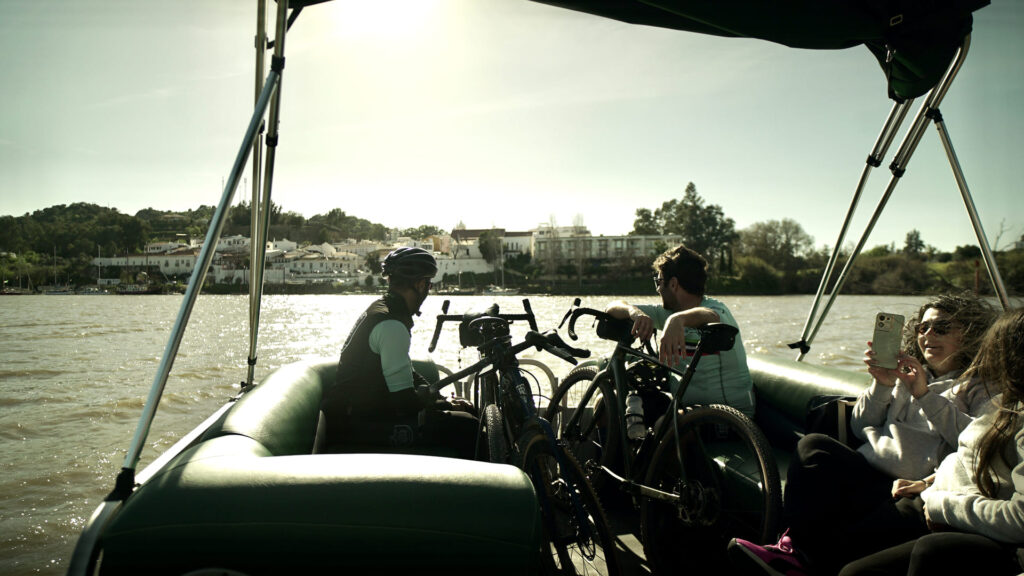
Crossing from Spain into Alcoutim, in the Algarve
The Algarve has a long association with road cycling, but the quality of the experience depends enormously on where you ride.
We generally avoid building routes around the busier coastal roads and resort areas. Instead, the best road cycling takes you away from the developed coastline and into the hills and quieter countryside of the western Algarve.
For that reason, Lagos is our favourite base for a road cycling holiday in the Algarve.
From here, you have several completely different directions to explore: west towards Sagres and Cape St. Vincent, north into the Serra de Monchique, or east and inland through a network of quieter secondary roads and traditional villages.
For a serious day on the bike, the Serra de Monchique is the obvious objective.
Rising to 902 metres, Fóia is the highest point in the Algarve and one of the region’s classic cycling climbs. The mountain regularly features in the Volta ao Algarve, but you don’t need to be a professional cyclist to appreciate the ride.
Starting around Lagos allows us to turn Fóia into a complete cycling day rather than simply driving to the bottom of the climb.
The roads gradually leave the coast behind as you ride north through the Algarve countryside. Traffic decreases, the terrain becomes increasingly rolling and eventually the longer climbing begins as you approach Monchique.
From the town, the road continues towards Fóia.
The summit itself is exposed and isn’t necessarily the prettiest part of the ride. What makes the experience special is the journey through the Serra de Monchique and the views that gradually open across the Algarve as you gain altitude.
On a clear day, you can see an extraordinary distance towards both the southern and western coastlines.
And, of course, what goes up eventually gets to come back down.
Fóia gets most of the attention, but road cyclists shouldn’t treat Monchique as a single out-and-back climb.
Some of our favourite riding is found on the quieter roads surrounding the mountain.
Routes through Marmelete can extend a Monchique ride towards the western Algarve, while roads towards Alferce, Odelouca and Silves allow us to create longer loops with considerable climbing and very little resemblance to the Algarve most visitors know from the coast.
This is where stronger road cyclists can build genuinely substantial days. You climb through cork and eucalyptus forests, descend into valleys, pass small villages and repeatedly gain and lose elevation as you cross the interior.
The roads aren’t famous in the way that Sa Calobra or the major Alpine passes are famous. That’s part of their appeal.
For a completely different road cycling day, head west.
The route towards Vila do Bispo and Sagres is more open and rolling than Monchique, with the landscape becoming increasingly exposed as you approach the Atlantic. Continue beyond Sagres and you eventually reach Cape St. Vincent, Portugal’s southwestern extremity.
There are no giant mountain passes here. Instead, the challenge often comes from the rolling terrain and, above all, the wind.
This part of the Algarve is exposed to the Atlantic, and a headwind can turn what looks like a straightforward ride on paper into a surprisingly demanding day.
But with enormous cliffs, ocean views and a lighthouse waiting at the end, few Algarve road rides have a better sense of destination.
For road cycling, we particularly like the Algarve in spring and autumn. Temperatures are generally comfortable, roads are quieter than during the peak holiday season and the conditions are well suited to longer rides and climbing.
Winter can also be surprisingly good and is one of the reasons professional teams have traditionally used the region for early-season riding and racing.
We generally avoid recommending July and August for serious road cycling. Temperatures can become very high inland, particularly on long climbing days, while traffic increases substantially around the coastal resorts.
If you’re coming to the Algarve primarily to ride a road bike, there are much better months to experience it.
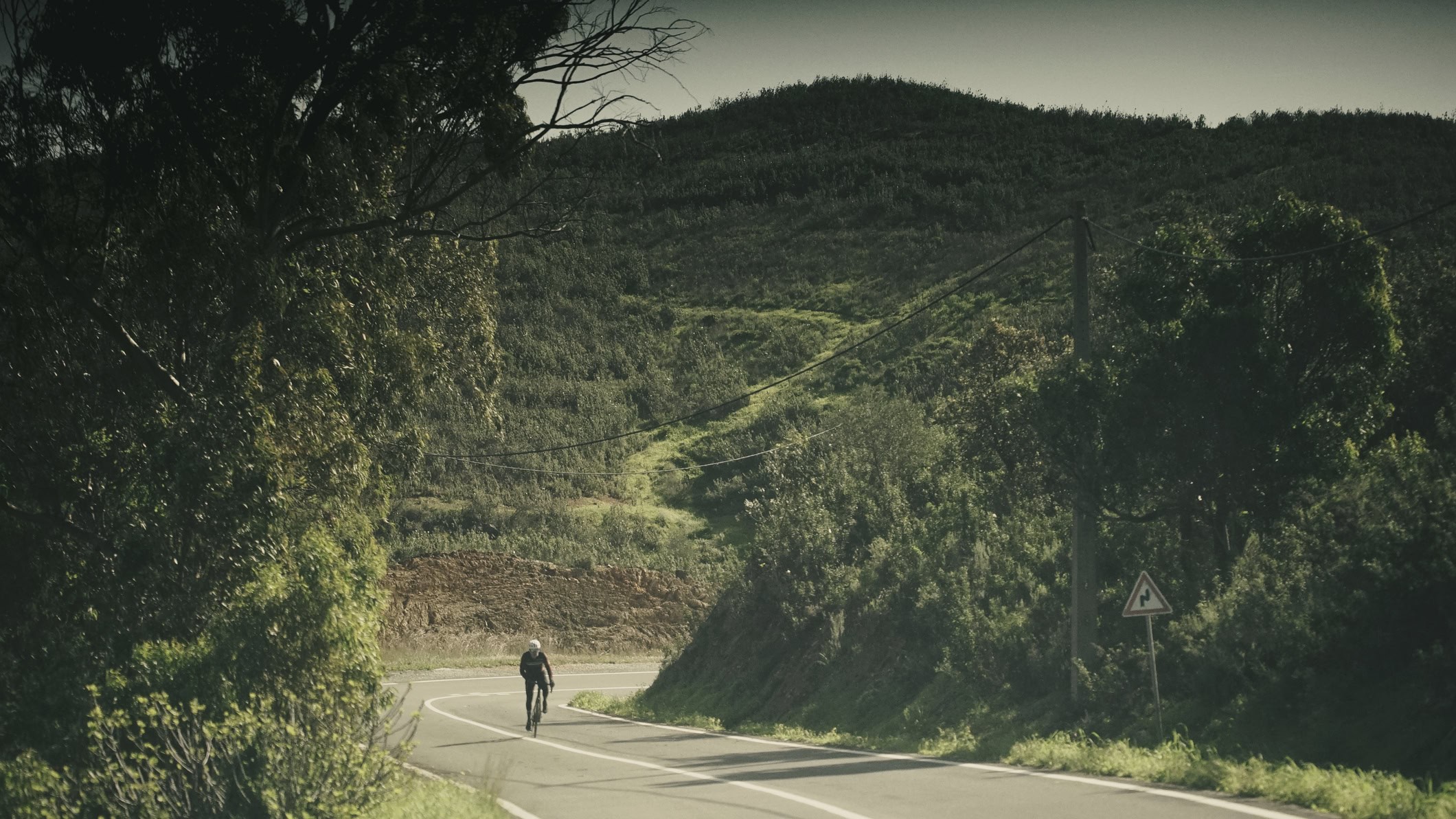
The western Algarve is particularly rewarding for intermediate and experienced road cyclists who enjoy rolling terrain, longer climbs and varied days rather than completely flat riding.
Less experienced riders can certainly enjoy these roads too, but route selection becomes important. An e-road bike can also be an excellent option, particularly for couples with different fitness levels or riders who want to explore Monchique without making the entire day about the climb.
Our Algarve cycling retreat in Lagos uses the town as a base for exactly this reason: from one hotel, we can access the coast, the western Algarve and the climbs of the interior, adapting each day’s ride to the cyclists and conditions.
For us, that’s the best way to experience the Algarve on a road bike tour.
The Algarve’s reputation as a road cycling destination is also reflected in the events held here, particularly during the early part of the European cycling season.
The most important is the Volta ao Algarve, one of Portugal’s leading professional stage races and part of the UCI ProSeries. Every February, the race attracts some of the world’s strongest professional teams and uses roads throughout the region.
For cyclists visiting the Algarve, watching the race is also a great introduction to some of the terrain we’ve described in this guide. Fóia and the Serra de Monchique regularly play an important role, with the 2026 edition including a 157 km mountain stage from Portimão to a summit finish at Fóia, accumulating more than 3,100 metres of climbing. Other familiar cycling locations across the Algarve, including Lagos, Tavira, Vila Real de Santo António and the Alto do Malhão, also feature regularly in the race.
Amateur cyclists can get involved too.
The Algarve Granfondo takes place alongside the Volta ao Algarve and gives recreational riders the opportunity to experience the region in an organised cycling event. Recent editions have offered both Granfondo and Mediofondo distances, making it accessible to different levels of experienced road cyclists.
For road cycling enthusiasts, February can therefore be a particularly interesting time to visit the Algarve. You can ride many of the same roads used by the professional peloton, experience the atmosphere surrounding the Volta ao Algarve and potentially combine your own cycling holiday with one of Portugal’s biggest weeks of cycling.
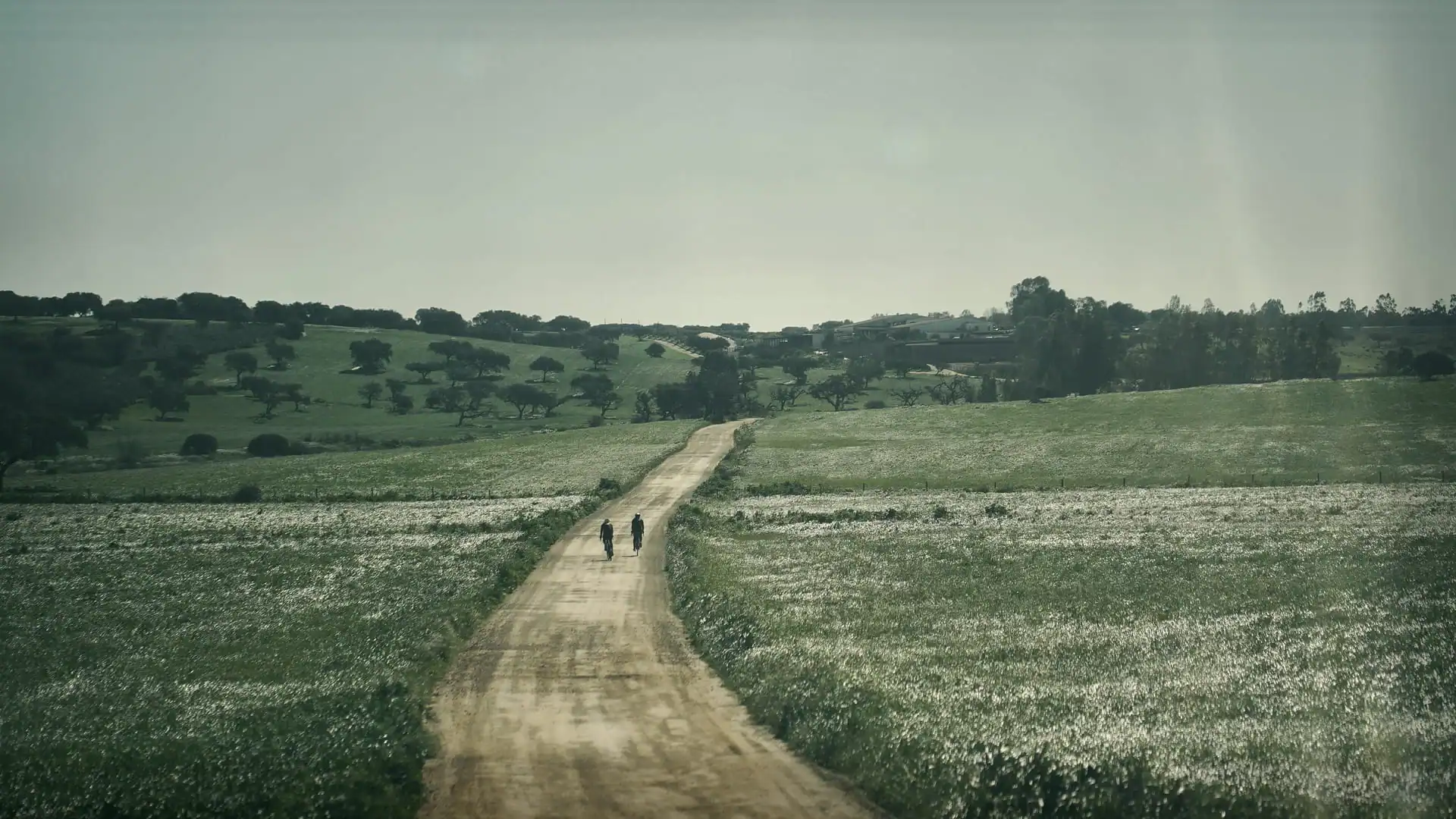
A gravel bike might be the most versatile way to explore the Algarve.
Away from the main coastal roads, an enormous network of rural tracks, unpaved roads and quiet country lanes crosses the region. A gravel bike allows us to connect them without having to choose between staying exclusively on asphalt or committing to technical mountain bike trails.
And there are two very different sides to gravel cycling here.
In the eastern Algarve, around the Guadiana, Castro Marim, Tavira and the Ria Formosa, the terrain is generally gentler. Gravel tracks cross wetlands, salt pans, agricultural landscapes and quiet countryside, making this a wonderful area for riders discovering mixed-terrain cycling.
Travel to the western Algarve and Southwest Coast, and the experience changes completely. Around Sagres, Carrapateira, Aljezur and Odeceixe, the landscape becomes wilder, hillier and more exposed, with Atlantic cliffs, remote beaches and rougher tracks.
Both are excellent gravel destinations.
They simply offer very different kinds of adventure.
The eastern Algarve doesn’t always receive the attention of Lagos, Sagres or the Southwest Coast, but it’s one of our favourite areas for relaxed gravel exploration.
Close to the Spanish border, the landscape around the Guadiana River and Castro Marim feels surprisingly remote. Quiet tracks and rural roads cross rolling countryside before descending towards the coast and the wetlands surrounding Castro Marim and Vila Real de Santo António.
This is a side of the Algarve many visitors never see.
Instead of resorts and busy coastal roads, you ride through open countryside, small villages, salt pans and protected natural landscapes, with Spain often visible across the Guadiana.
As you travel west, the landscape gradually transitions into the Ria Formosa, one of Portugal’s most important coastal wetland systems.
Around Cacela Velha, Tavira and the eastern Ria Formosa, the terrain becomes generally flatter and the riding more relaxed. Tracks and quiet roads pass salt pans, lagoons, agricultural land and small communities, often with views towards the barrier islands separating the lagoon from the Atlantic.
Tavira makes a particularly good focal point.
Its historic centre, riverfront and position beside the Ria Formosa make it an excellent place to combine cycling with the slower side of an Algarve holiday. Rather than chasing elevation, the pleasure here comes from exploring the landscape and having the freedom to leave the paved road whenever a more interesting track appears.
This is also an excellent introduction to gravel cycling for riders who are confident on a bicycle but don’t necessarily have extensive off-road experience.
Best for: Recreational and intermediate gravel riders, nature and landscape
Terrain: Rural tracks, quiet roads and generally non-technical gravel
Best bike: Gravel bike or e-gravel bike
Difficulty: Easy to moderate
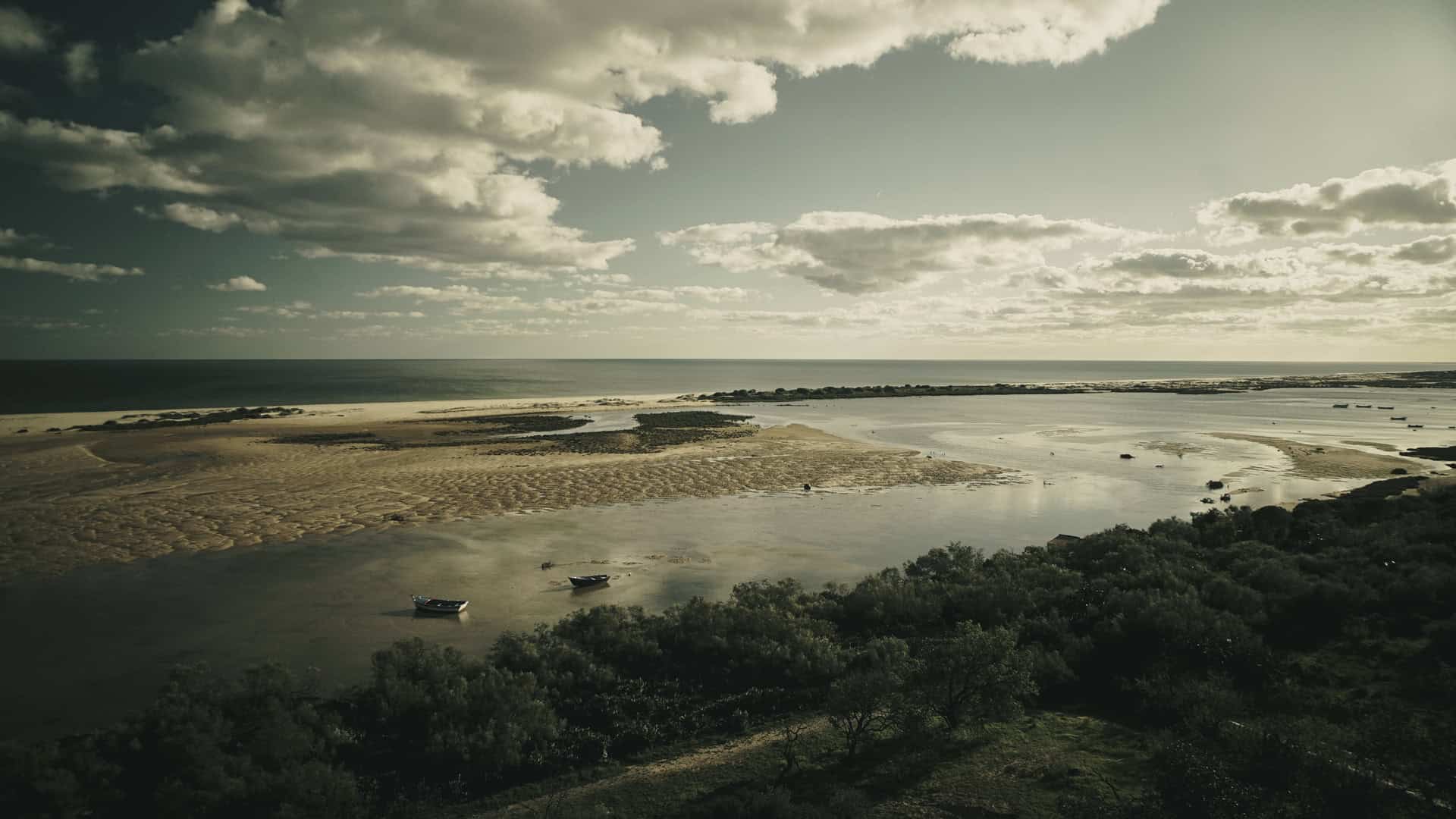
Head west and gravel cycling takes on a completely different character.
Around Sagres and the southwestern tip of Portugal, the sheltered southern coastline meets the Atlantic and the landscape becomes increasingly open, exposed and rugged.
Turn north and you enter the Costa Vicentina, one of the wildest stretches of coastline in Portugal.
The terrain here is more rolling than in the eastern Algarve, the surfaces can be rougher and the Atlantic wind can add another challenge. But for riders looking for a greater sense of adventure, it’s one of our favourite areas in Portugal to ride a gravel bike.
Leaving Sagres and heading north takes you through Vila do Bispo and into increasingly remote countryside.
Around Carrapateira, a gravel bike allows you to move between quiet roads and rural tracks through a spectacular coastal landscape.
The beaches of Bordeira and Amado give you an idea of just how different this part of the Algarve is from the south coast. Huge expanses of sand sit beneath cliffs facing directly into the Atlantic, with relatively little development surrounding them.
Continue north and Aljezur becomes a natural hub for exploring the region.
The whitewashed old town sits beneath the ruins of its hilltop castle, while quiet roads and tracks lead towards some of the Southwest Coast’s most beautiful beaches, including Arrifana, Monte Clérigo and Amoreira.
The pleasure of riding gravel here comes from being able to move naturally between coast and countryside.
Sometimes the best connection is paved. Sometimes it’s a rural dirt road. Sometimes a gravel track leads towards a viewpoint or beach that would make little sense to reach on a road bike.
You don’t need to decide in advance which kind of cycling you’re doing.
That’s the point.
North of Aljezur, the Southwest Coast remains wonderfully undeveloped.
Routes continue through a mixture of quiet roads, rural tracks and rolling countryside towards Odeceixe, close to the border between the Algarve and Alentejo.
The riding isn’t necessarily highly technical, but surfaces can vary considerably. That’s precisely why a gravel bike works so well.
You have enough efficiency for longer paved sections while wider tyres provide greater stability and comfort when the route moves onto dirt.
Odeceixe itself is a beautiful place to finish an Algarve gravel journey.
Its whitewashed village overlooks the valley of the Ribeira de Seixe, while the nearby beach sits at the mouth of the river where the Algarve meets the Alentejo.
But your journey doesn’t need to finish there.
Continue north and the same style of cycling can take you along Portugal’s Southwest Coast into the Alentejo, creating one of the country’s great multi-day cycling journeys.
The Rota Vicentina has become one of the most important outdoor recreation networks in southwestern Portugal and offers extensive possibilities for cyclists.
Its dedicated cycling network includes hundreds of kilometres of routes for gravel and mountain bikes, allowing riders to explore the countryside surrounding places such as Vila do Bispo, Carrapateira, Aljezur and Odeceixe without simply following one predetermined trail.
There is, however, an important distinction to make.
The famous Fishermen’s Trail is for walkers, not cyclists.
It frequently follows narrow trails through sensitive dune systems and along the cliffs and should not be treated as a cycling route. Cyclists should instead use the dedicated Rota Vicentina cycling network, suitable public tracks and roads.
This is something we take seriously when designing our own routes.
A hiking trail that looks spectacular on a map isn’t automatically a good place to ride a bicycle.
The Algarve is also crossed by EuroVelo 1, the Atlantic Coast Route, part of a much larger European cycling route following Europe’s western coastline.
Across the Algarve, EuroVelo 1 connects the Spanish border and eastern Algarve with Faro and the southern coast before reaching Lagos and Sagres.
From Sagres, it turns north through the Southwest Coast towards Carrapateira, Aljezur and Odeceixe, continuing into the Alentejo.
For touring cyclists, EuroVelo 1 provides a useful backbone for a longer journey across the Algarve.
But we don’t think you need to follow every kilometre religiously.
One of the advantages of a gravel bike is being able to combine sections of EuroVelo 1 with quieter roads and appropriate off-road alternatives, particularly where the Rota Vicentina cycling network gives you a more interesting way to experience the landscape.
The objective isn’t to follow a line on a GPS device.
It’s to find the best way through the Algarve.
It doesn’t have to be.
This is an important distinction because gravel riding and mountain biking are not the same thing. The gravel routes we favour are generally built around unpaved roads, rural tracks and non-technical trails rather than difficult singletrack, large rocks or aggressive descents.
There can still be loose surfaces, sand, steeper gradients and rough sections, particularly along the Southwest Coast. Riders should therefore be comfortable cycling away from smooth asphalt.
But you don’t need to be an expert mountain biker to enjoy gravel cycling in the Algarve.
The eastern Algarve is particularly good for riders new to gravel, with gentler terrain and plenty of opportunities to combine unpaved tracks with quiet roads.
The Southwest Coast offers the natural progression: longer climbs, rougher surfaces and a more adventurous landscape for riders who already feel comfortable on mixed terrain.
What makes gravel particularly interesting in the Algarve is that the bicycle works equally well in two completely different landscapes.
In the east, it allows us to leave the main roads and explore the countryside, salt pans and wetlands between the Guadiana and Ria Formosa. In the west, the same bike takes us onto the rural tracks and backroads of the Costa Vicentina, where cliffs, Atlantic beaches and remote landscapes create a much wilder cycling experience.
A road bike encourages you to search for good asphalt. A mountain bike allows you to search for trails. A gravel bike lets you stop worrying quite so much about either.
Our gravel bike tour in the Algarve is designed around that philosophy, using mixed surfaces to explore parts of the region that are easy to miss when you stay on the main roads.
We aren’t trying to maximise the percentage of every day spent off-road.
We choose the surface that creates the best journey through the destination.
And in a region as varied as the Algarve, that’s exactly why gravel works so well.
The Algarve can also be a superb mountain biking destination, particularly for riders who want to explore the wilder landscapes of the Southwest Coast.
A mountain bike gives you more freedom than a gravel bike when surfaces become rougher, steeper or more technical, allowing us to use trails and tracks that we would deliberately avoid on narrower tyres.
And while the Algarve has serious mountain biking in its interior, some of our favourite MTB journeys are actually found between the Atlantic coast and the rural landscapes surrounding Sagres, Aljezur and Odeceixe.
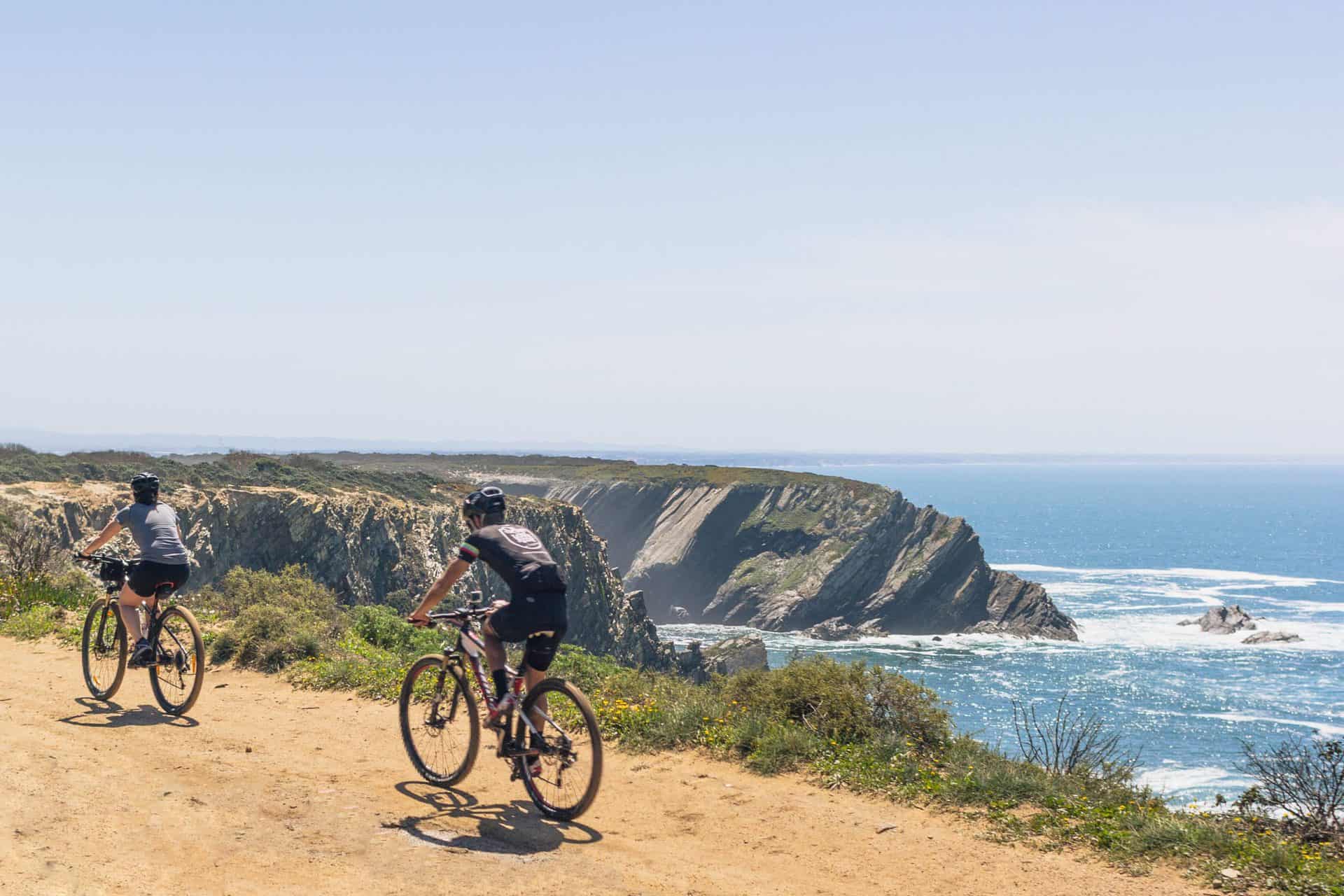
The Southwest Coast is particularly well suited to multi-day mountain bike journeys.
Between Sagres, Carrapateira, Aljezur and Odeceixe, networks of rural tracks and trails move constantly between the Atlantic coastline and the quieter countryside inland.
The landscape is spectacular. One moment you’re riding through open countryside or cork oak landscapes; the next, the trail brings you towards enormous beaches and cliffs overlooking the Atlantic.
A mountain bike becomes particularly useful where the terrain is rougher. Wider tyres and greater stability give riders more confidence on loose surfaces, steeper tracks and uneven trails while still allowing you to cover meaningful distances each day.
The Rota Vicentina has also developed an extensive official MTB and gravel network, with more than 1,000 km of cycling trails and different difficulty levels across Southwest Portugal.
For experienced riders, this means the Southwest Coast doesn’t need to be treated simply as a point-to-point route. There are enough trails to build additional loops and explore much deeper into the landscape.
Our own Southwest Coast bike tours use this terrain to create a journey rather than simply a collection of technical trails. That’s an important distinction for us.
We’re not designing an enduro holiday or trying to find the hardest piece of singletrack available. We use mountain bikes because they allow us to travel comfortably through rougher terrain while experiencing the villages, beaches, countryside and landscapes of Southwest Portugal.
Both can work extremely well, but they create different experiences.
A gravel bike is faster and more efficient on smoother dirt roads and paved sections. For confident cyclists who enjoy a more responsive riding position, it’s an excellent way to travel along the Southwest Coast.
A mountain bike provides greater stability and comfort when the terrain becomes rougher. Wider tyres and a more upright position make it a better option for riders who prioritise confidence over speed or who want the freedom to include more demanding trails.
For many recreational riders, we’d rather put them on a mountain bike and let them enjoy the landscape than put them on a gravel bike simply because gravel happens to be fashionable.
The best bike is the one that suits the rider, the terrain and the journey.
Away from the Southwest Coast, the Algarve interior offers a very different kind of mountain biking.
The Serra do Caldeirão and Serra de Monchique contain a network of tracks and long-distance trails crossing hills, forests, valleys and remote rural communities.
The best-known long-distance route is the **Via Algarviana (GR13)**, which crosses the Algarve interior between Alcoutim, near the Spanish border, and Cape St. Vincent.
It’s worth knowing about, particularly for experienced riders planning their own MTB adventure, but we wouldn’t present the entire GR13 as a straightforward mountain bike touring route.
Some sections can be physically demanding, steep or rough, and route conditions can vary. Following a GR line on a map is very different from riding one of the routes we’ve specifically designed and tested for our guests.
For riders interested in exploring the interior, we’d therefore recommend researching individual sections carefully and choosing the route according to technical ability, fitness and current trail conditions.
The Algarve’s mountain biking credentials are perhaps best demonstrated by the Algarve Bike Challenge.
Based in Tavira, the three-day stage race takes riders away from the flatter coastal landscapes of the eastern Algarve and into the Barrocal and Serra do Caldeirão.
The event covers around 150 km with approximately 3,500 metres of climbing, and about 95% of the race course uses dirt roads, trails, singletrack and unpaved forest roads.
It’s an excellent illustration of something that can surprise first-time visitors to the Algarve.
You can be standing beside the Ria Formosa on almost completely flat terrain and, within the same part of the region, access genuinely demanding mountain biking in the hills inland.
The organisers rate the overall technical level around 3.5 out of 5, with some short sections reaching higher levels of difficulty. So this is not the kind of riding we’d recommend to a beginner simply because they happen to be comfortable on a bicycle.
But for experienced mountain bikers, events like the Algarve Bike Challenge demonstrate just how much serious off-road terrain exists beyond the beaches and coastal towns.
You don’t necessarily need to be an expert mountain biker.
For our style of multi-day cycling, a mountain bike can simply be the most comfortable and confidence-inspiring tool for exploring mixed and rougher terrain.
We particularly recommend one when the journey includes longer stretches of uneven tracks, loose surfaces or trails where the additional stability makes the day more enjoyable.
More experienced riders can take things considerably further, exploring the technical trails of the Algarve interior or the extensive MTB network of the Southwest Coast. Our approach remains the same either way:
We don’t choose the most difficult trail simply because it’s there. We choose the route that creates the best journey.
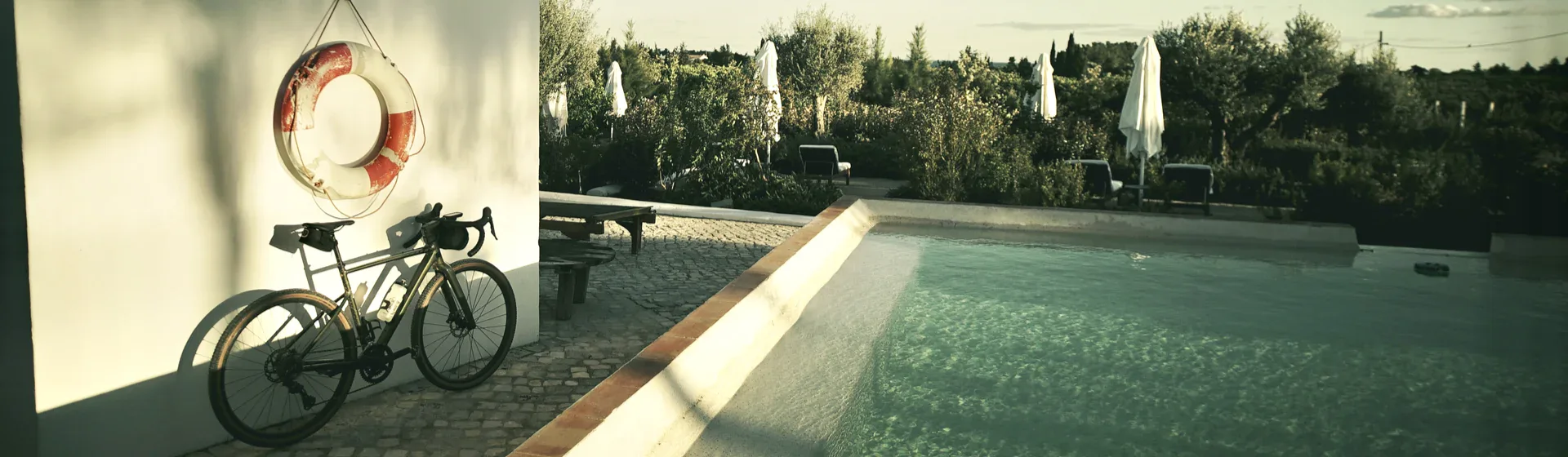
Not every cycling holiday in the Algarve needs to involve long climbs, technical trails or big days in the saddle.
For riders who want to experience the landscape at a comfortable pace, touring bikes and e-bikes are two of the best ways to explore the region.
This style of cycling is particularly well suited to the coast, where the objective is less about performance and more about travelling from place to place: riding through fishing communities, stopping in historic towns, crossing protected natural landscapes and having enough time left in the day to enjoy a beach, a long lunch or a glass of wine.
For an easier cycling holiday, we particularly like the eastern Algarve.
Starting around Vila Real de Santo António and Castro Marim, relatively gentle terrain allows you to explore the landscapes surrounding the Guadiana and Spanish border before travelling west towards Cacela Velha, Tavira and the Ria Formosa.
There are still hills, and no multi-day cycling journey is completely flat, but compared with Monchique or the western Algarve, this is considerably more accessible terrain.
Tavira is one of our favourite stops.
The historic town sits on the Gilão River, surrounded by the lagoons, salt pans and barrier islands of the Ria Formosa. It’s exactly the kind of place where travelling by bicycle makes sense: arrive slowly, explore the town, enjoy the local food and continue west the following morning.
Our Algarve Coastal Bliss bike tour begins in Vila Real de Santo António and follows this philosophy across the Algarve. Daily stages are generally 25 to 41 km with around 200 to 400 metres of elevation, making it one of our most accessible cycling journeys in southern Portugal.
A touring bike is ideal for riders who enjoy cycling but don’t necessarily want the aggressive position or performance focus of a road or gravel bike.
The more upright riding position makes it easier to look around and enjoy the landscape, while stable handling and comfortable geometry work well for consecutive days in the saddle.
They’re particularly suited to the easier coastal sections of the Algarve, where quiet roads and cycling paths allow you to move comfortably between towns and landscapes.
For recreational cyclists who are reasonably active and comfortable riding the daily distances, a touring bike keeps the experience simple.
You pedal. You travel. You stop when something catches your attention.
An e-bike offers much of the same comfortable cycling experience but adds electric assistance when you need it.
That can make a significant difference in the Algarve.
While the eastern Algarve is relatively gentle, the terrain becomes progressively more rolling as you travel west. An e-bike allows recreational cyclists to continue exploring without having to plan the entire journey around avoiding hills.
It’s also one of the best solutions for couples or friends with different fitness levels.
A stronger cyclist can ride a conventional bike while their partner uses an e-bike, allowing both riders to share the same route without one person constantly waiting or the other struggling to keep up.
And electric assistance doesn’t mean you stop cycling. You still pedal throughout the ride and choose how much assistance you want from the motor.
The difference is that a climb doesn’t necessarily dictate how much energy you have left to enjoy the rest of the day.
This is where e-bikes begin to separate themselves from conventional touring bikes.
A touring bike is particularly well suited to the flatter eastern and coastal routes.
An e-bike can take the same recreational rider considerably further.
The rolling roads of the western Algarve become more manageable, longer stages become less intimidating and even hillier areas can become realistic options for riders who wouldn’t normally consider them.
Our Algarve portfolio reflects this versatility. The relaxed Coastal Bliss journey is available on both touring bikes and e-bikes, while our Southwest Coast bike tour can also be ridden on an e-bike despite its more demanding terrain.
So choosing an e-bike doesn’t necessarily mean choosing an easy route. It can simply mean having more Algarve available to you.
Choose a touring bike if you’re comfortable with the planned distances and elevation, enjoy pedalling entirely under your own power and want a relaxed, upright riding position.
Choose an e-bike if you’re concerned about hills, haven’t been cycling regularly, want to ride with a stronger partner or simply prefer to save more energy for everything else the journey has to offer.
For beginners who are unsure about their fitness, we generally recommend the e-bike.
The objective isn’t to prove how strong you are.It’s to finish each day’s ride wanting to get back on the bicycle tomorrow. And for many travellers, that’s exactly what makes an e-bike such a good way to discover the Algarve.
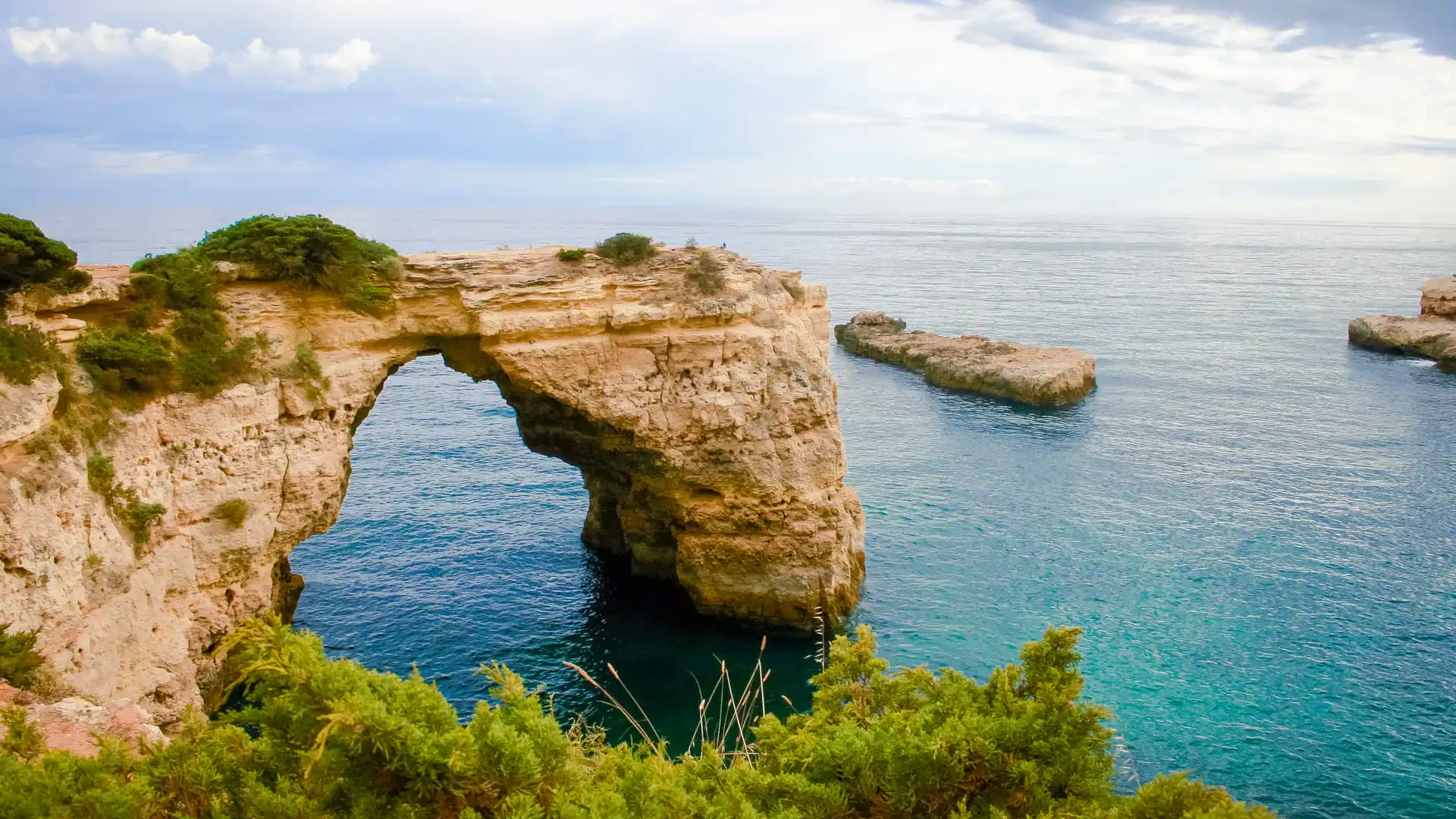
One of the Algarve’s biggest advantages as a cycling destination is its long riding season. While many European cycling regions are strongly seasonal, southern Portugal can offer good riding conditions through much of the year. The Algarve receives more than 3,000 hours of sunshine annually, and even winter temperatures are relatively mild.
For most cycling holidays, however, our favourite periods are spring and autumn.
Spring is one of the best times to cycle in the Algarve.
Temperatures are generally comfortable for longer days on the bike, the countryside is greener than during summer and the region is considerably quieter than during the peak holiday months.
It’s a particularly good season for road cycling, when longer rides into Monchique and Fóia are much more pleasant than during the heat of summer.
For gravel and mountain biking, spring is equally attractive. The Southwest Coast is beautiful at this time of year, while the countryside of the eastern Algarve and Ria Formosa can be explored without the intense heat of midsummer.
If we had to recommend a first-time visitor one period for an Algarve cycling holiday, April and May would be difficult to beat.
Summer is when most travellers think of visiting the Algarve.
For a beach holiday, that makes perfect sense. For a cycling holiday, we’re less convinced.
June can still offer good riding, particularly if you start early, but July and August are not our preferred months for serious cycling. Temperatures can become high, particularly once you leave the coast and ride inland, and the main resort areas are at their busiest.
Long road rides towards Monchique become considerably more demanding in the heat, while exposed gravel and mountain bike routes can offer very little shade. If you do ride during summer, start early, carry plenty of water and plan the route conservatively.
And there’s another reason we prefer other seasons: the Algarve is simply more enjoyable to explore by bicycle when you aren’t sharing its busiest roads and towns with peak summer traffic.
Autumn is another of our favourite periods. September can still feel distinctly summery, particularly early in the month, but conditions gradually become more comfortable as the season progresses.
October is one of our favourite months for cycling in the Algarve. The intense summer heat has usually passed, the largest tourist crowds have disappeared and the sea and landscape still retain the feeling of southern Portugal.
It’s excellent for almost every kind of riding we’ve described in this guide: road cycling around Lagos and Monchique, gravel in the eastern Algarve, mountain biking and gravel along the Southwest Coast, or a relaxed touring journey across the region.
November can also provide excellent cycling days, although the probability of rain increases as you move towards winter.
Winter is where the Algarve becomes particularly interesting compared with many other European cycling destinations.
It’s not guaranteed sunshine every day. November through February are the wetter months, and winter weather systems can certainly bring rain and wind. But temperatures remain relatively mild, particularly along the coast. Official Algarve road-cycling climate data gives January an average temperature of around 11.9°C and notes that Faro receives more than 3,000 hours of sunshine annually.
That makes winter cycling a realistic proposition rather than something reserved for the exceptionally hardy.
For road cyclists, February is particularly interesting because it coincides with the Volta ao Algarve and Algarve Granfondo. You can ride the same region while some of the world’s best professional cyclists are racing across it.
Winter can also be excellent for gravel and mountain biking, although recent rainfall can obviously affect trail conditions.
The trade-off is simple: conditions are less predictable than in spring or autumn, but you’ll find a much quieter Algarve and the possibility of genuinely excellent riding days in the middle of the European winter.
If we had to simplify it:
March to May: Excellent – one of our favourite periods
June: Good, but increasingly warm
July and August: Hot and busy – generally not our choice for a cycling holiday
September and October: Excellent – another favourite
November: Good, with greater chance of rain
December to February: Mild and quiet, but weather is less predictable
For most guests, we’d choose March, April, May, September or October.
But the Algarve’s real advantage isn’t that one month is perfect. It’s that when much of Europe has stopped cycling, the Algarve often hasn’t. And that extended season is one of the reasons the region has become such an important destination for cyclists.
A cycling journey through the Algarve isn’t only interesting because the landscape changes from east to west. The food, towns and traditions change with it too.
And this is one of the reasons we enjoy travelling through the region rather than simply basing ourselves in a resort and riding loops every day.
On a bicycle, the Algarve unfolds slowly: a coffee in a village square, lunch beside a fishing harbour, a market in a historic town or fresh seafood at the end of a day beside the Atlantic.
In the eastern Algarve, life has always been closely connected to the sea and the wetlands of the Ria Formosa.
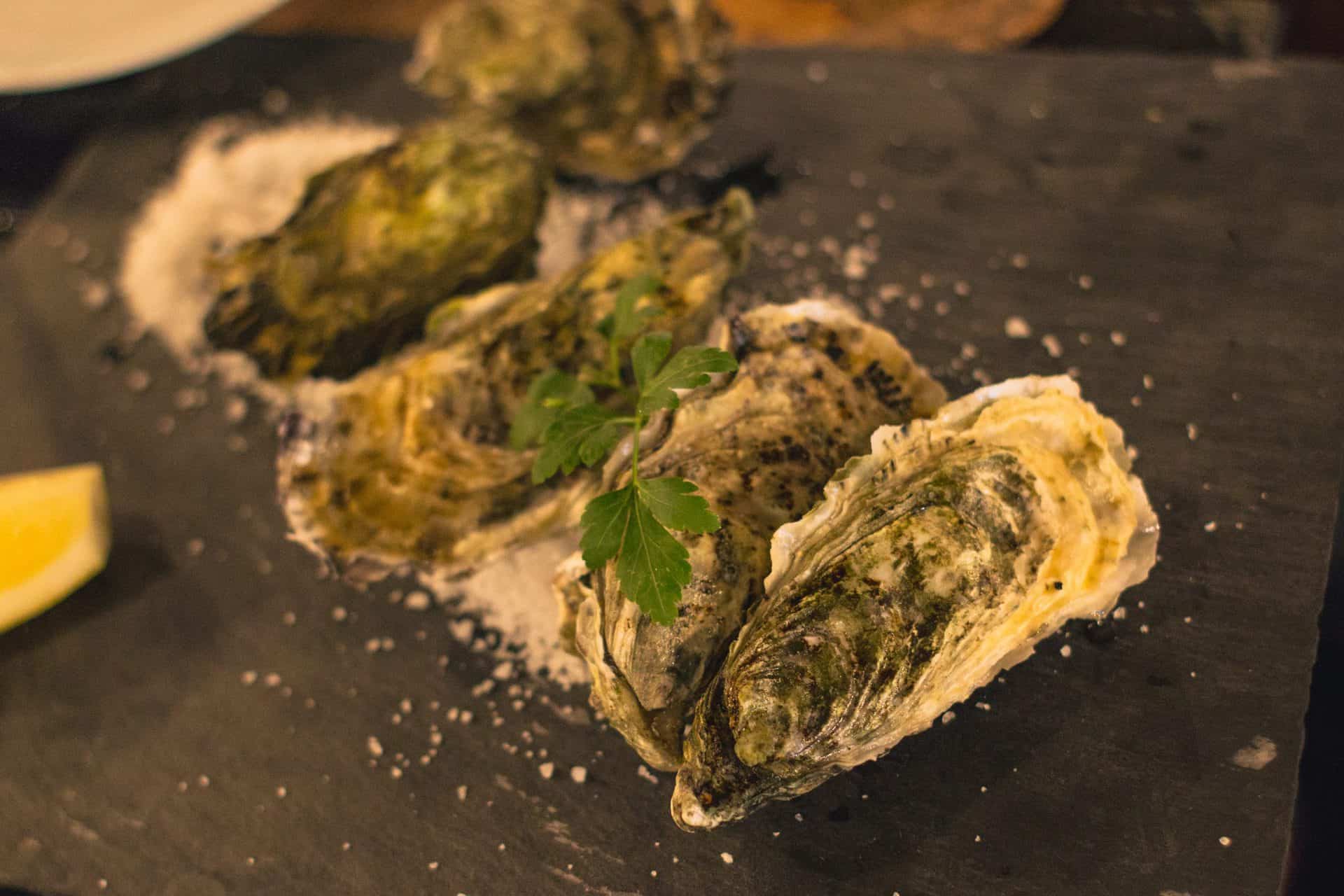
Around Vila Real de Santo António, Cacela Velha, Tavira, Santa Luzia and Olhão, fish and shellfish dominate many traditional menus. Santa Luzia is particularly associated with octopus, while the waters of the Ria Formosa are known for oysters, clams and other shellfish.
If you’re cycling around Tavira, one of our favourite places to stop is Noélia e Jerónimo in Cabanas de Tavira. Chef Noélia Jerónimo’s cooking is deeply connected to the fish, shellfish and ingredients of the Ria Formosa. It’s enormously popular, so this is one place where planning ahead is a good idea.
Another local favourite is Os Fialhos, near Luz de Tavira. This is the kind of traditional seafood restaurant we love incorporating into a cycling day: straightforward Portuguese cooking, fresh fish and seafood, and a location that makes perfect sense when exploring the eastern Algarve by bike.
This is also where you’ll see the Algarve’s traditional salt pans. Salt production has shaped these landscapes for centuries, and riding beside the geometric salt ponds around Tavira and Castro Marim is one of the distinctive experiences of cycling in the eastern Algarve.
As you continue west, don’t simply ride through Olhão.
Make time for the Mercado de Olhão, one of our favourite food stops in the Algarve. Its unmistakable market buildings sit directly beside the Ria Formosa and remain closely connected to the city’s fishing and agricultural traditions.
Go in the morning, walk through the fish and produce markets and buy something for the ride: fruit, bread, cheese or whatever looks good that day.
For us, places like this are part of the pleasure of exploring Portugal by bicycle. You’re not just riding through the landscape; you’re able to stop and experience how people actually live and eat there.
Tavira deserves time off the bike.
The town developed around the Gilão River, with narrow streets, churches, traditional houses and the remains of its castle overlooking the historic centre. It feels very different from the large resort developments elsewhere on the Algarve coast.
That’s one reason we enjoy incorporating towns like Tavira into a cycling journey. You’re not simply sleeping somewhere because it happens to be 50 kilometres from yesterday’s hotel.
The destination itself is part of the experience.
Further west, Lagos and Sagres introduce another side of the Algarve.
Lagos was an important port during Portugal’s maritime expansion, and its historic centre still contains reminders of that history. Today it combines that heritage with one of the most spectacular coastal landscapes in southern Portugal, particularly around Ponta da Piedade.
After a good day on the bike, head towards Praia do Camilo and stop for fresh fish and seafood overlooking this dramatic stretch of the Lagos coastline.
It’s exactly the kind of place that fits our idea of a cycling holiday: a beautiful ride followed by fresh fish and seafood beside the Atlantic, rather than finishing the day’s stage and treating dinner as an afterthought.
Sagres feels different again. The landscape becomes sparse and exposed as you approach Cape St. Vincent, and the relationship with the Atlantic becomes impossible to ignore.
After riding there, understanding why sailors once regarded this corner of Europe with a mixture of fascination and apprehension isn’t particularly difficult.
Head into the hills and the food changes with the landscape.
Monchique is known for products from the mountains and surrounding countryside, including cured meats, honey and medronho, the traditional spirit distilled from the fruit of the strawberry tree.
This is another reason we like taking cyclists inland. The Algarve isn’t culturally defined only by fishing villages and beaches. Its mountain communities developed around a very different landscape and way of life.
A ride into Monchique can therefore feel like travelling much further than the relatively short distance from the coast suggests.
Around Carrapateira, Aljezur and Odeceixe, the Atlantic once again dominates. This isn’t necessarily where we’d go looking for elaborate fine dining every evening.
Part of the appeal is simpler: fresh fish, seafood, local produce and small restaurants in towns and villages where the surrounding landscape still dictates much of the experience.
After a day riding gravel or mountain bikes along the Costa Vicentina, sitting down to grilled fish and a cold drink can be every bit as memorable as the trail that brought you there.
There are a few dishes and ingredients worth looking out for during a cycling trip:
But we’d resist turning a cycling holiday into a checklist of dishes. The pleasure is often much simpler.
Ride somewhere beautiful. Stop when you’re hungry. Eat what that particular part of the Algarve does well.
The bicycle has a remarkable ability to make lunch taste better.
Knowing where to ride in the Algarve is one thing. Knowing which roads and trails actually create a great cycling journey is another.
At Live Love Ride, we’ve been designing and operating cycling holidays in Portugal for more than a decade. The Algarve is one of the regions where that local experience matters most, because the quality of the riding can change enormously from one road or trail to the next.
We operate with a local team and bike station in Faro, rather than managing our Algarve tours from somewhere else in Europe.
That means our team is close to the routes we ride, our bikes are maintained locally and we can continually explore and refine our itineraries.
It’s also why this guide is so specific.
We know that a recreational cyclist may love the quieter terrain around Tavira and the Ria Formosa, while a road cyclist is better based around Lagos for access to Monchique. We know where gravel works beautifully around the Guadiana and where a mountain bike becomes the better tool on the Southwest Coast.
And just as importantly, we know the roads and urban areas we’d rather avoid.
Every Live Love Ride journey in the Algarve is designed and operated by our own team. We don’t simply package somebody else’s itinerary.
We scout the routes, select the hotels and experiences, organise the logistics and support our guests throughout the journey. On self-guided tours, you follow routes we’ve designed and tested ourselves, with navigation and local support available along the way.
For guided journeys, our guides add another layer to the experience: adapting the ride when necessary and introducing you to the places, people, food and stories you might otherwise pass by.
The right bike can completely change your experience of the Algarve.
We operate our own fleet of premium Specialized road, gravel, mountain, touring and e-bikes, professionally maintained and fitted to each rider before the journey begins.
That variety matters here.
The bike we’d recommend for exploring the salt pans and quieter roads around Tavira isn’t necessarily the bike we’d choose for climbing Fóia or riding rougher trails along the Southwest Coast.
We’ll help you choose the bike that matches both the terrain and the way you like to ride.
Some cyclists want a guide beside them. Others want the freedom to ride independently. We offer both.
Our guided Algarve bike tours provide the knowledge, support and company of an experienced local team, while our self-guided journeys give you greater independence with carefully designed routes, navigation, pre-arranged accommodation and support when you need it.
You can also join selected departures or make your journey private, depending on the experience you’re looking for.
We love bicycles, but we don’t believe a great cycling holiday should be judged only by kilometres and elevation.
The reason we ride through Tavira is also to experience the Ria Formosa and stop for seafood. The reason we climb into Monchique isn’t simply to accumulate elevation. And when we ride towards Sagres, Cape St. Vincent is part of what makes the journey memorable.
Our Algarve tours combine the riding with carefully selected hotels, local gastronomy, culture and the time to actually experience the places you’re travelling through.
Because ultimately, the bicycle is the way we travel. The Algarve is the reason we’re there.
Yes. The Algarve is one of Portugal’s most varied cycling regions, with flatter coastal riding in the east, road climbing around Monchique, gravel and mountain biking on the Southwest Coast and an unusually long cycling season.
The important thing is choosing the right area, route and bike for the kind of riding you enjoy.
It can range from very accessible to genuinely challenging.
The eastern Algarve around Vila Real de Santo António, Tavira and the Ria Formosa offers some of the gentlest terrain. The western Algarve is more rolling, while Monchique and Fóia provide proper climbing for road cyclists.
Off-road difficulty also varies considerably. Gravel tracks can be relatively straightforward, while MTB and GR routes in the interior can become steep, rough and technical.
Absolutely.
For beginners, we’d particularly recommend the eastern Algarve and easier coastal routes, ideally on an e-bike if you’re concerned about fitness or hills.
An e-bike allows you to enjoy the landscape without having to choose your entire itinerary according to elevation, and is also a great solution for couples with different fitness levels.
Our favourite periods are spring and autumn, particularly April, May, September and October.
Winter can also offer excellent riding and is one of the Algarve’s big advantages over colder European cycling destinations.
We generally don’t recommend July and August for a dedicated cycling holiday. The Algarve is hotter, busier and the inland climbs can become uncomfortable during the middle of the day.
It depends entirely on the experience you’re looking for.
A touring bike or e-bike works particularly well for relaxed coastal journeys. Choose a road bike for Lagos, Monchique and Fóia; a gravel bike for mixed-surface exploration in the eastern Algarve and Southwest Coast; or a mountain bike when the trails become rougher and more technical.
There isn’t one perfect Algarve bicycle. There is a perfect bicycle for the route you want to ride.
Yes, but it’s important to understand what you’re following.
Rota Vicentina has a dedicated cycling network with more than 1,000 km of MTB and gravel routes, as well as a long-distance MTB route and a separate touring-bike route.
However, the famous Fishermen’s Trail is exclusively for walkers and cycling it is prohibited. It includes narrow cliffside trails and extensive sandy sections and should not be treated as a bike route.
For cycling, use the dedicated Rota Vicentina cycling network and suitable public roads and tracks instead.
Yes. EuroVelo 1, the Atlantic Coast Route, crosses the entire Algarve.
The official route enters from Vila Real de Santo António and continues through Faro, Albufeira, Portimão, Lagos and Sagres before turning north through Carrapateira, Aljezur and Odeceixe towards the Alentejo.
It’s a useful backbone for a longer cycling journey, although we often prefer selecting quieter or more interesting alternatives where appropriate rather than following every kilometre of a long-distance route simply because it’s marked.
Faro Airport is the most convenient gateway for most Algarve cycling holidays.
If you’re travelling with your own bicycle, check your airline’s bicycle requirements and the current bike policies of any trains or buses you intend to use.
For point-to-point journeys, transfers can simplify things considerably because the start and finish may be far apart. On our tours, we organise the relevant bike, guest and luggage logistics as part of the journey.
Both options work.
Bring your own if having your exact setup is important to you, particularly for performance road cycling or racing.
Renting locally avoids flying with a bike box, assembling the bicycle after arrival and transporting or storing the box during a point-to-point journey.
At Live Love Ride, we operate our own fleet of premium Specialized road, gravel, mountain, touring and e-bikes, which we prepare and fit to each rider before the tour.
Choose guided if you want a local guide riding with you, more support throughout the day and someone to introduce you to the landscape, culture and places along the route.
Choose self-guided if you enjoy travelling independently and want more freedom over your pace and stops while still having a professionally designed route, navigation, accommodation and local support.
Neither is inherently better. It depends on how independently you like to travel.
For a cycling retreat based in one location, three or four days can already provide an excellent introduction to the region.
For a point-to-point journey across the Algarve, we’d allow around a week. That gives you time to actually experience the towns, landscapes and food rather than simply trying to cover the region as quickly as possible.
If you’re continuing north through the Southwest Coast into the Alentejo, the journey can easily become a longer cycling holiday.
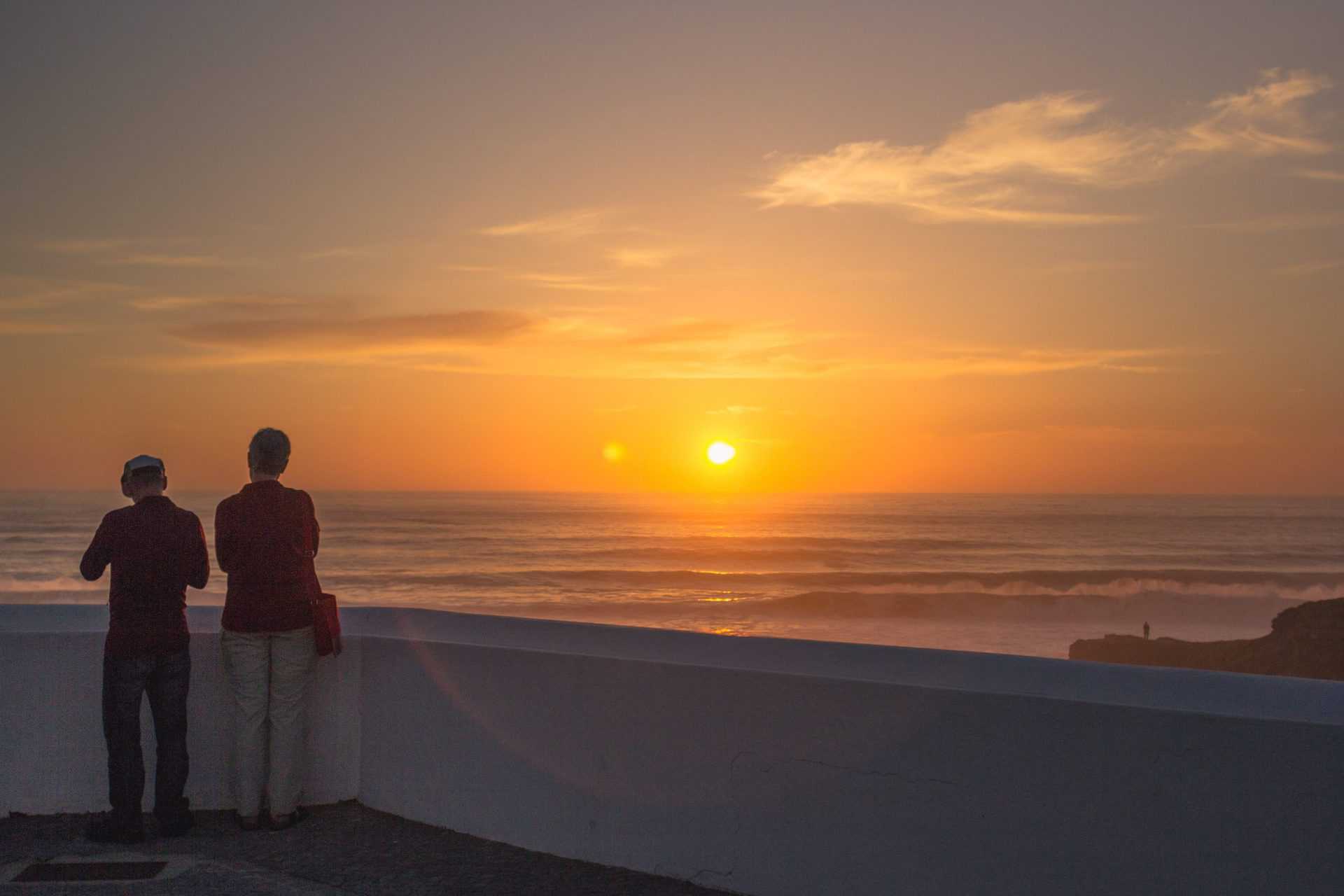
The Algarve isn’t one cycling destination. It’s several very different ones packed into the same corner of Portugal.
You can ride through the salt pans and wetlands of the Ria Formosa, follow quiet roads between traditional towns in the eastern Algarve, climb into the Serra de Monchique, explore the wild Atlantic landscapes around Sagres or continue north by gravel or mountain bike along the Southwest Coast.
Our Algarve bike tours are designed around those differences, with journeys for road, gravel, mountain, touring and e-bikes and options for different levels of cycling experience.
Whether you’re looking for a relaxed coastal journey or something more adventurous, our local team can help you choose the route and bike that best match the way you like to ride.
Explore all our Algarve bike tours
Discover more of Portugal by bike
The Algarve is just one part of an extraordinarily varied cycling country. Ride through the vineyards of the Douro Valley, cross the open landscapes of the Alentejo, follow the Portuguese Camino towards Santiago or explore Portugal’s Atlantic coastline from Porto to Lisbon.
Browse all our cycling destinations in Portugal to compare the different regions, or read our complete guide to cycling in Portugal for our advice on where to ride, when to travel and which part of the country best suits your cycling style.
The question isn’t whether Portugal is worth exploring by bike. It’s which part you want to ride next.
This is an ongoing article written by Pedro Rocha, from Live Love Ride – if you feel you’d like to contribute with more information regarding cycling in the Algarve and enrich it with your favourite rides, please drop us an e-mail with your suggestions at ridewitus (@)liveloveride.pt
If the Algarve’s sunshine and long cycling season appeal to you, you might also want to look across the Mediterranean to our Mallorca bike tours. Mallorca combines spectacular coastal roads with the legendary climbs of the Serra de Tramuntana, including Sa Calobra and Cap de Formentor, as well as quiet inland roads, Mediterranean villages and excellent local gastronomy. It’s a very different cycling experience from the Algarve, but another of our favourite destinations for escaping colder weather and enjoying some of Europe’s finest riding.