
Starting in Porto, the route travels inland through small villages, vineyards, farmland and some of the most historic towns in the north of the country. Ponte de Lima, Portugal’s oldest chartered town, is one of its great highlights, followed by the more challenging landscapes towards the Spanish border and the extraordinary fortified town of Valença overlooking the Minho River.
Cross the bridge into Tui and you enter Galicia. From here, the Central and Coastal routes eventually converge, bringing increasing numbers of pilgrims together for the final journey through Pontevedra and Padrón towards Santiago de Compostela.
For cyclists, the Central Camino has a noticeably different personality from the coast.
It is more rugged, more undulating and slightly more challenging, particularly through the Portuguese section. Expect cobbled lanes, rural roads, forest tracks, old paths and steeper gradients, alongside sections of wonderfully quiet cycling through a side of northern Portugal that many visitors never see.
At Live Love Ride, we specialize in cycling holidays in Portugal, and our permanent team at our Porto Bike Station regularly rides, scouts and supports guests along the Portuguese Camino. In this guide, we’ll share what you need to know about cycling the Central Portuguese Camino, from terrain and difficulty to bike choice, navigation and the stages we most enjoy riding.
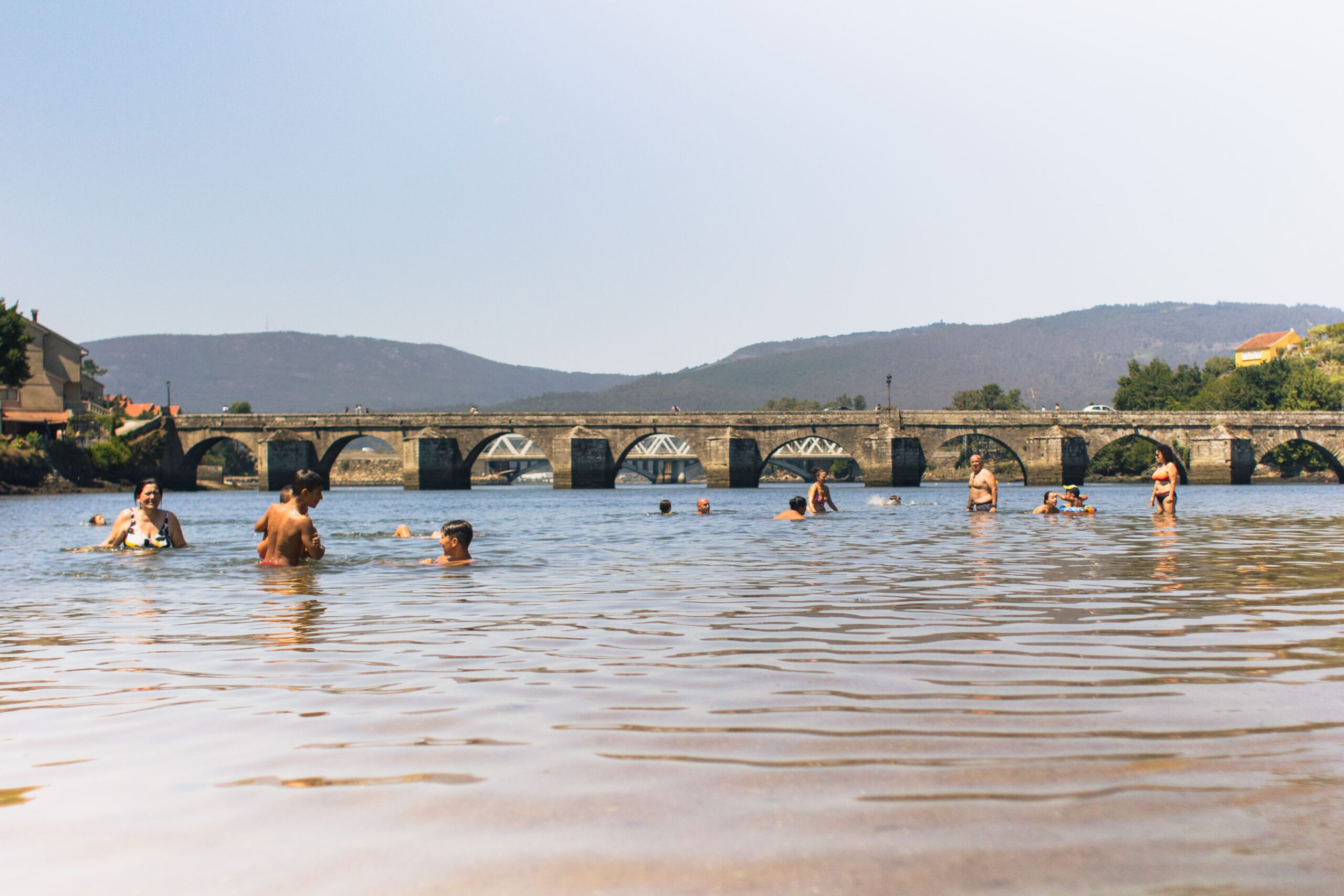
Ponte Sampaio’s old bridge, that you get to cross in the Portuguese Camino
Start: Porto, Portugal
Finish: Santiago de Compostela, Spain
Countries: Portugal and Spain
Recommended riding time: 5 to 7 riding days
Rider level: Intermediate, or recreational riders with appropriate preparation/e-bike assistance
Character: Historic, inland, rural and more traditional
Terrain: Paved roads, cobbles, forest tracks, gravel, rural lanes and Camino paths
Difficulty: Moderate, with some steeper and more rugged sections
Bike options: Mountain bike, gravel bike or e-bike
Navigation: Camino markings combined with a cycling-specific GPS track
Highlights: Porto, Barcelos, Ponte de Lima, Valença, Tui, Pontevedra, Padrón and Santiago de Compostela
The Central Way is the classic inland route of the Portuguese Camino.
For much of the journey through Portugal, it feels very different from the Coastal Camino. Instead of following the Atlantic, you ride north through the countryside of the Minho, connecting historic towns, villages, churches, vineyards and agricultural landscapes.
There is a stronger sense of travelling through Portugal rather than around its coastline.
That distinction becomes particularly apparent as you move north.
Barcelos introduces you to the traditions and legends of the Portuguese Camino. Ponte de Lima combines one of northern Portugal’s most beautiful historic centres with a landscape that signals the more demanding riding ahead. Valença then provides a spectacular conclusion to the Portuguese section, with its enormous fortress looking across the Minho River towards Spain.
The riding itself also feels more adventurous.
There are smooth roads and easy kilometres, but they are mixed with cobbles, woodland, rougher tracks and steeper climbs. For us, that’s part of the Central Camino’s appeal.
You work a little harder for this route.
And the landscape rewards you for it.
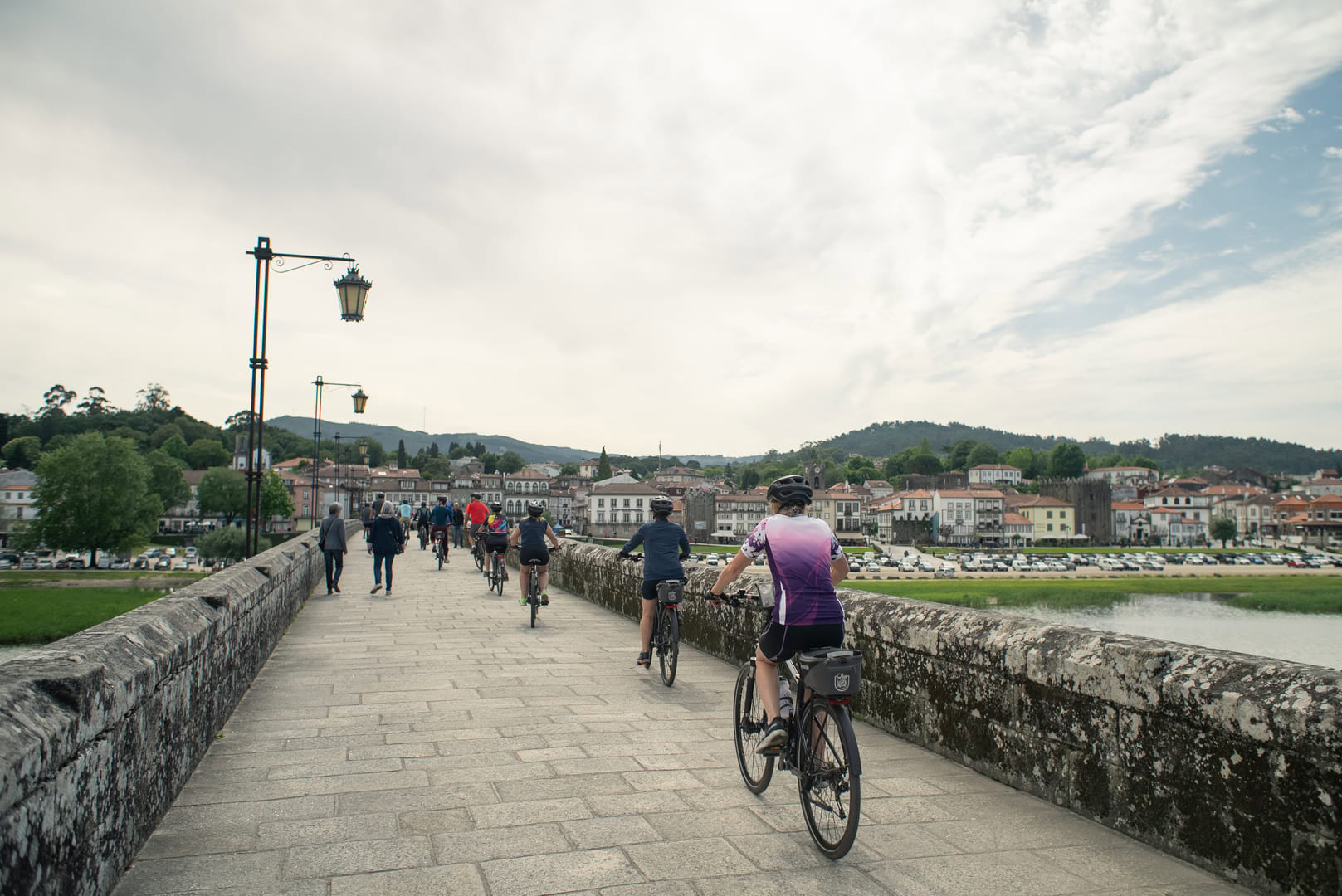
Crossing Ponte de Lima historical bridge
The two routes share the same starting point and ultimate destination, but the experience between them is quite different.
The Coastal Camino heads towards the Atlantic and is characterized by ocean scenery, boardwalks, fishing communities and coastal towns.
The Central Camino heads inland and gives you a more rural view of northern Portugal, passing through traditional towns, agricultural landscapes, vineyards and forest.
It is also generally the more challenging of the two routes for cyclists.
That doesn’t mean you need to be an expert rider. But the combination of steeper gradients, rougher surfaces and more sustained climbing means bike choice and route planning become particularly important.
If you enjoy the idea of a more rugged Camino and want to experience the historic interior of northern Portugal, the Central route has enormous appeal.
If you’d rather have the Atlantic as your companion for much of the Portuguese section, read our complete guide to cycling the Portuguese Coastal Camino.
And if you don’t want to choose between them, there are also ways to combine some of the best sections and variants of the Portuguese Way into a more curated Camino journey, like our Best of the Portuguese Camino Signature tour
We would describe the Central Camino as moderately challenging, although the difficulty depends heavily on how closely you follow the original walking route.
This distinction matters.
The Camino was created for pilgrims on foot. Some of its historic tracks and cobbled sections are wonderful to experience by bicycle. Others can be unnecessarily technical, steep or uncomfortable, particularly for less experienced riders.
A well-designed cycling route therefore requires judgement.
At Live Love Ride, we don’t simply download the walking route and send guests along it. We scout the Camino from a cyclist’s perspective and make route choices that preserve its character while avoiding sections that don’t make sense on the bike.
The Portuguese part contains some of the more demanding riding, particularly as you travel deeper into the Minho.
The area around Ponte de Lima and Labruja is especially important when planning the route. The traditional Camino crosses rugged terrain here, and cyclists need to consider both their bike and technical confidence before deciding exactly how closely to follow the walkers’ path.
An experienced mountain biker may enjoy sections that a recreational touring cyclist would much rather bypass.
That’s not “missing” the Camino.
It’s designing the right Camino for the rider.
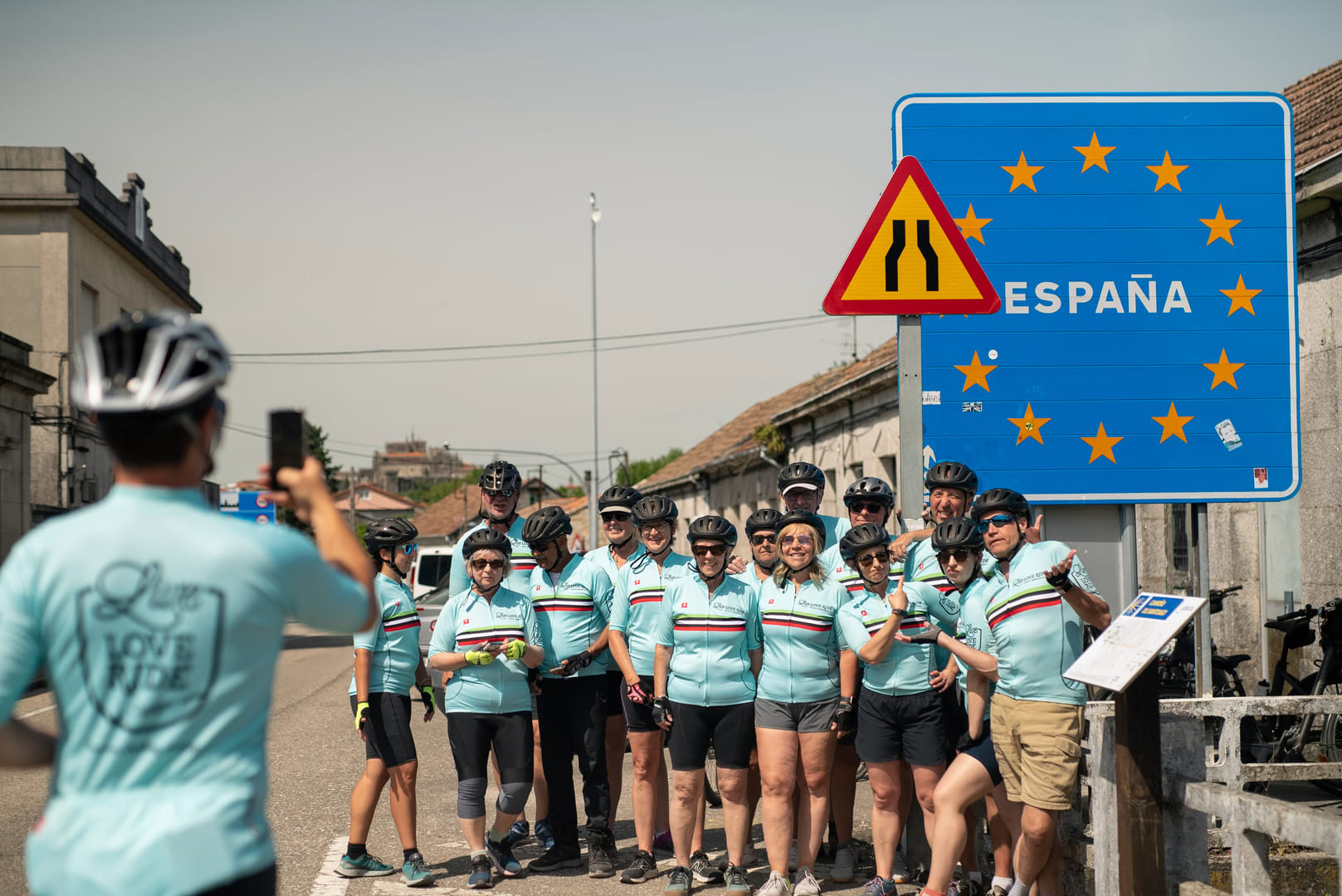
Cycling into Galicia, from Valença to Tui, in the Central Portuguese Camino de Santiago
Variety is one of the defining features of cycling the Central Camino.
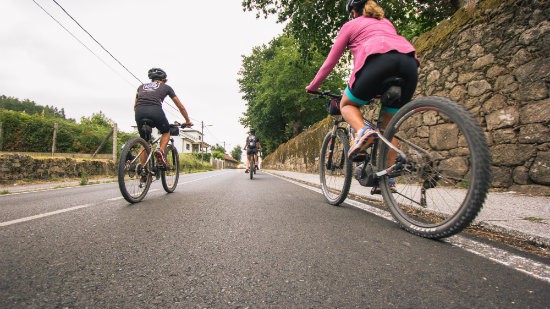
Over the course of a single stage, you might encounter smooth asphalt, narrow country lanes, granite cobbles, compact gravel, woodland tracks and older pilgrim paths.
The Portuguese section in particular can feel more rugged than cyclists expect.
Cobbles are worth mentioning because northern Portugal has plenty of them. They’re part of the landscape and part of the character of riding through historic villages and towns, but repeated kilometres over uneven surfaces can be tiring.
Rain also changes the character of unpaved sections considerably.
A dry forest track that is straightforward one day can become much slower after sustained rain.
This is another reason why having a route designed specifically for bicycles, rather than simply following a walking GPX track, matters.
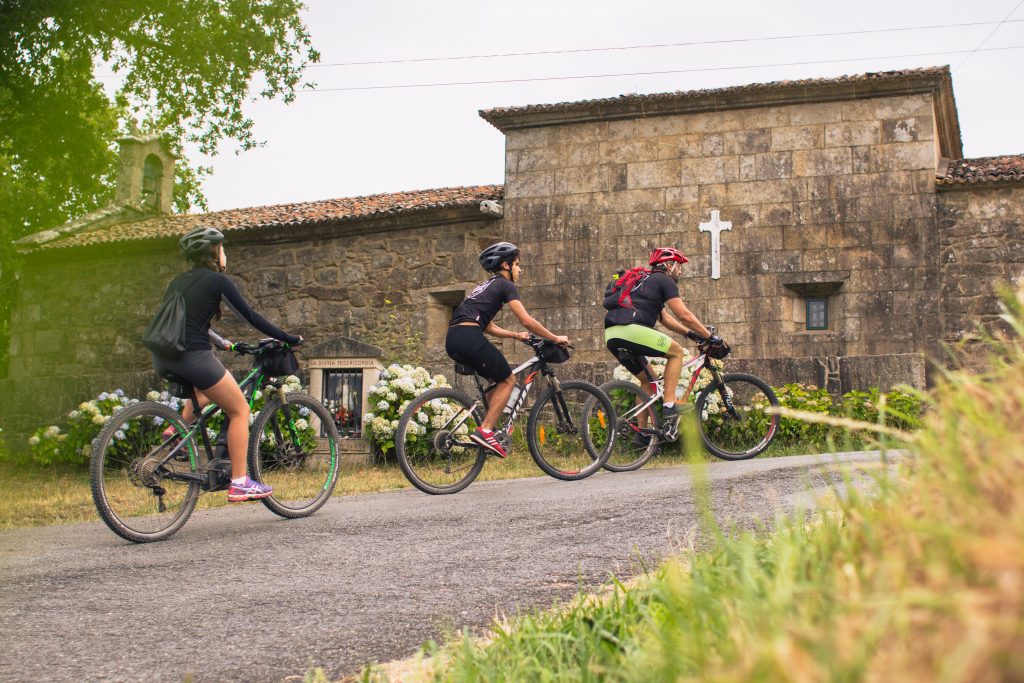
Bike choice is arguably even more important on the Central route than on the Coastal Camino.
For riders who want to remain closest to the original Camino and enjoy its rougher sections, a hardtail mountain bike is one of our preferred choices.
The wider tires, stability and front suspension provide additional confidence on cobbles, forest tracks and more irregular terrain.
You sacrifice some speed on paved roads, but outright speed isn’t particularly important on the Camino.
A gravel bike can be an excellent choice for experienced and technically confident riders.
It is faster and more efficient on the road while remaining capable on many of the unpaved sections.
However, the roughest Camino terrain and steep cobbled sections require more skill on a gravel bike than on a mountain bike.
For that reason, we don’t recommend gravel simply because someone is a strong road cyclist. Bike-handling confidence matters too.
For most riders, a mountain bike with a recreational geometry is our preferred choice for the Central Portuguese Camino.
The more upright riding position provides comfort over consecutive days, while wider tires, front suspension and greater stability make a real difference on the Camino’s cobbles, forest tracks, gravel and more rugged sections.
This doesn’t need to be an aggressive cross-country racing bike. In fact, for most guests we prefer a mountain bike designed around comfort, control and an upright riding position. It allows recreational cyclists to tackle the varied terrain with greater confidence while still being efficient enough for the paved sections between trails.
For riders who want to experience more of the original character of the Central Camino rather than regularly diverting onto paved alternatives, this is the bike we would recommend.
An e-bike is an excellent option for the Central Camino.
The assistance becomes particularly valuable on the repeated climbs of northern Portugal and Galicia, and it allows riders with different fitness levels to experience the journey together.
An e-bike doesn’t remove the need to ride or handle the bicycle. But it can make the difference between worrying about the next climb and actually enjoying it.
The principal cycling season runs from spring through autumn.
Spring is particularly beautiful inland. Northern Portugal is green, the countryside is active and temperatures are generally comfortable for climbing.
There is, however, a greater possibility of rain, and rain has more impact on the Central route because of its forest tracks, cobbles and unpaved surfaces.
Early summer brings longer days and generally more predictable conditions.
July and August can be warmer, particularly away from the cooling influence of the Atlantic, so starting earlier in the morning becomes more important.
September and early autumn can be excellent, with pleasant riding temperatures and beautiful light across the Minho countryside.
Whatever the season, pack for changing conditions.
Northern Portugal and Galicia are green for a reason 😉
The yellow Camino arrows and scallop shells remain your companions all the way north.
But on the Central route, cycling-specific navigation is particularly important.
Following every walking arrow can lead you onto steep or technical sections that may be enjoyable for some mountain bikers but inappropriate for other cyclists.
We recommend combining Camino signage with a properly designed GPS route.
The objective isn’t to remove the adventure.
It is to ensure that the adventure is appropriate for the person riding the bike.
On Live Love Ride’s Portuguese Camino bike tours, our routes are developed and refined by our local cycling team and provided digitally for navigation, while our Porto-based operation remains close to guests travelling north through Portugal.
The famous yellow arrows pointing towards Santiago de Compostela
There are several ways to divide the Central Camino. Daily stages should ultimately reflect rider ability, accommodation choices and how closely you want to follow the traditional route.
This itinerary gives you a sense of how the journey can unfold.
Porto is much more than a convenient place to start riding.
Give yourself enough time to walk through the historic centre, descend towards Ribeira and look across the Douro towards the Port wine lodges of Vila Nova de Gaia.
For pilgrims, however, the most important landmark is the Sé do Porto.
The Cathedral stands high above the river and is the traditional starting point for many people travelling north along the Portuguese Camino.
The following morning, you leave the city behind and begin following the yellow arrows north.
Live Love Ride insider tip: Visit the Sé before your riding day to collect your pilgrim credential and first Camino stamp. Starting with a stamped credential in your pocket changes the psychology of the trip. Porto stops being simply your departure city and becomes the beginning of your Camino.
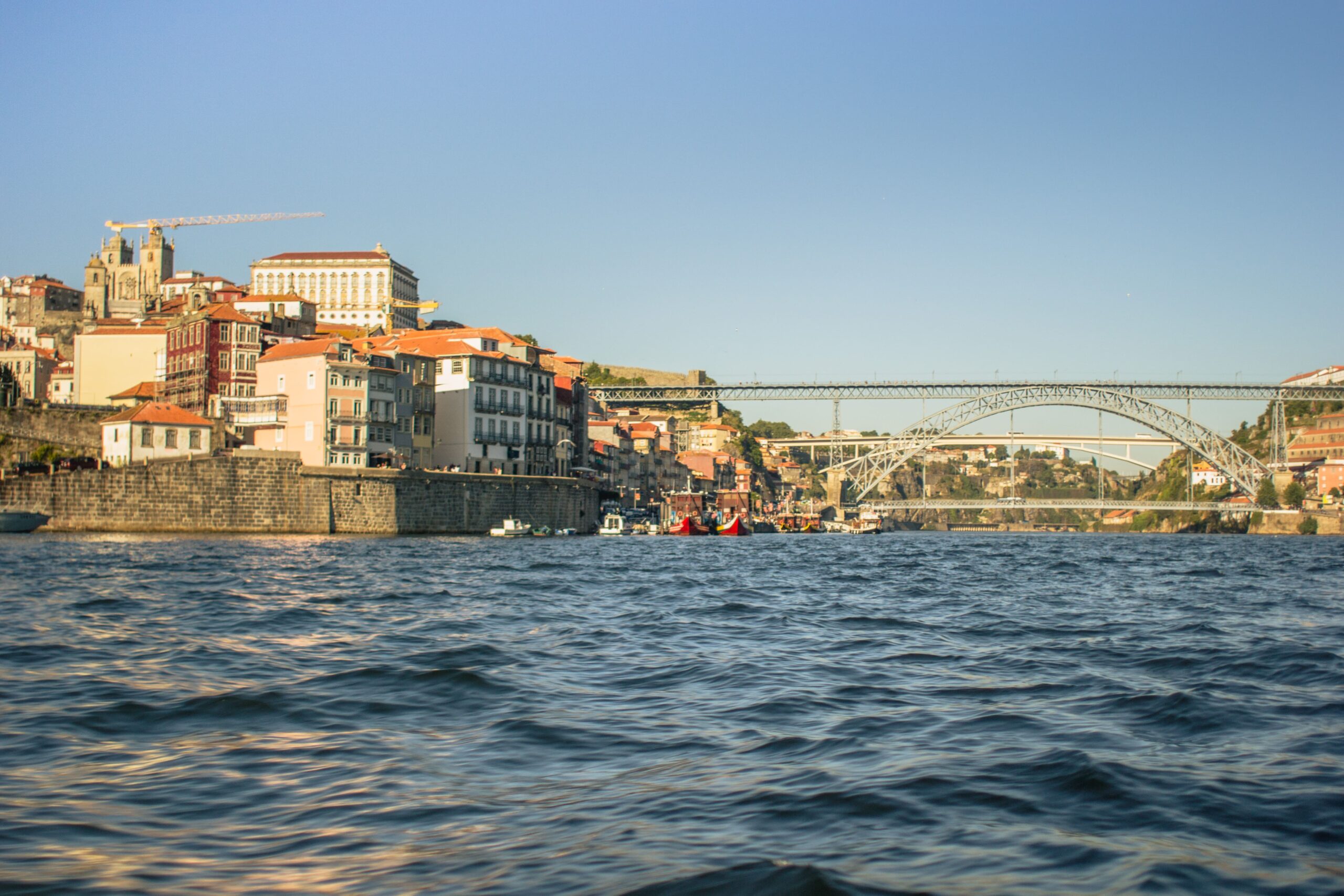
Take your time to explore Porto before starting tour tour
Leaving a major city is rarely the most romantic part of a pilgrimage, and the opening kilometres take you gradually away from metropolitan Porto.
But the landscape changes.
Urban surroundings give way to smaller communities, agricultural land and the quieter roads and paths of northern Portugal.
The Central Camino begins revealing its character through a mixture of paved surfaces, cobbles and rural tracks.
Your destination is Barcelos, one of the historic towns most closely associated with the Portuguese Way.
The famous Portuguese rooster, the Galo de Barcelos, is connected to a medieval legend involving a pilgrim travelling to Santiago, giving a familiar Portuguese symbol a direct Camino connection.
Live Love Ride insider tip: Don’t leave Barcelos without learning the story behind the Galo de Barcelos and the pilgrim saved by the rooster. You’ll see the colourful rooster all over Portugal, but here the symbol makes much more sense. Finish the day with a walk through the historic centre rather than heading straight to your hotel.
For us, this is where the Central Camino really begins to show why it is special.
The route travels deeper into the Minho through an increasingly rural landscape of fields, vineyards, small villages and woodland.
The riding continually changes between paved roads, traditional lanes and Camino tracks.
Eventually, you approach Ponte de Lima, one of the great highlights of the entire Portuguese Camino.
The town takes its name from the bridge crossing the Lima River. Its historic centre, riverside setting and long relationship with the Camino make it much more than another overnight stop.
There is a wonderful sense of arrival as you reach the river and see the bridge stretching ahead.
Live Love Ride insider tip: Give yourself time for a late-afternoon walk along the Lima River and across the historic bridge. Ponte de Lima is one of those places where arriving early is worth more than adding another 20 kilometres to the ride. If you’re interested in wine, this is also Vinho Verde country, so try a local glass with dinner.
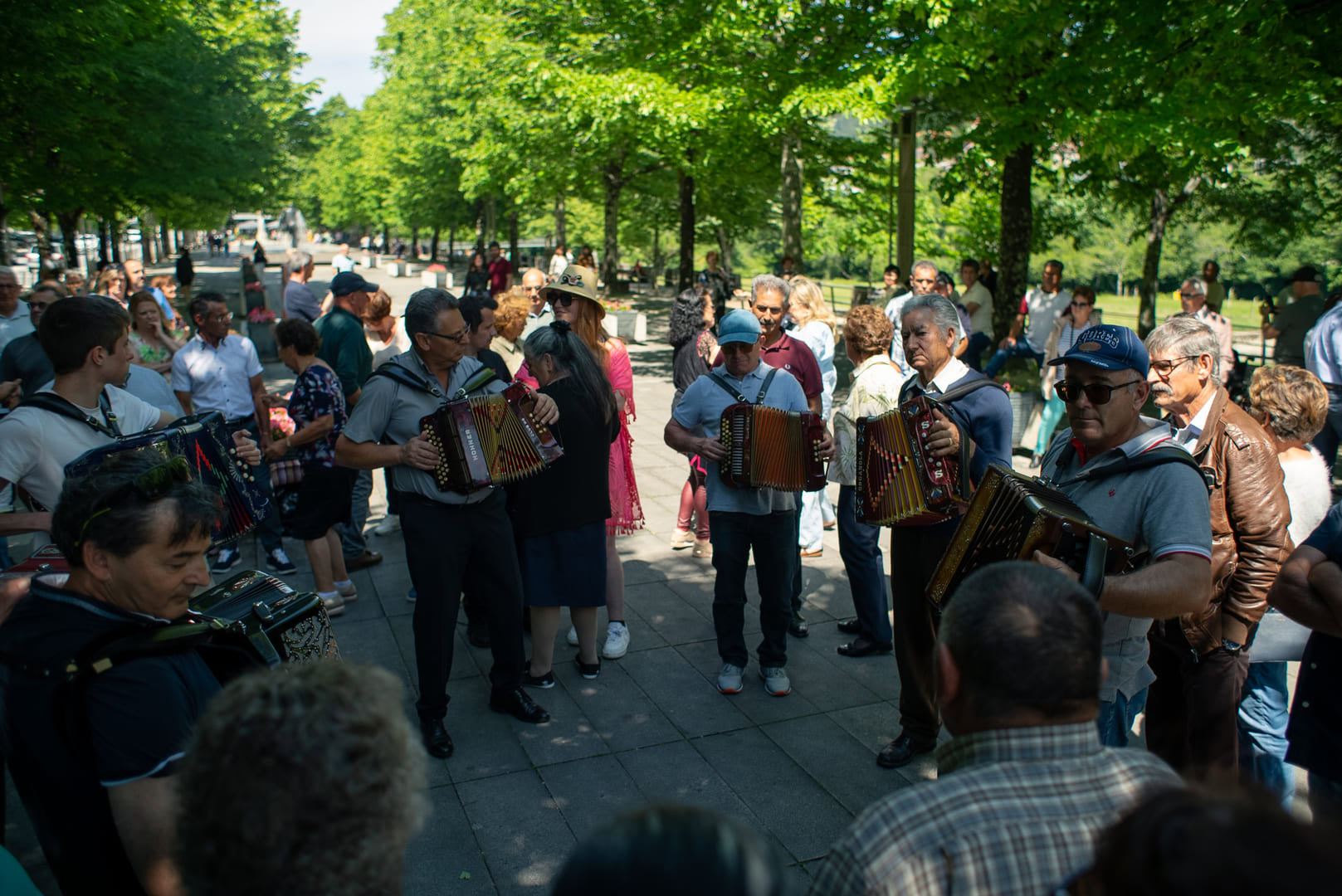
Impromptu Concertina concert in Minho
This is one of the defining days of the Portuguese Central Camino.
Leaving Ponte de Lima, the route enters a more rugged landscape as it heads north towards the Labruja area.
For walkers, this is one of the best-known climbs on the Portuguese Way. For cyclists, it is also where intelligent route selection becomes especially important.
Depending on bike type, weather and technical ability, we may adapt parts of the traditional route rather than force every cyclist through terrain better suited to hiking or mountain biking.
Beyond the climbing, the landscape opens again as the Camino continues north towards the Spanish border.
And then comes Valença.
The town’s enormous double-walled fortress sits high above the Minho River, looking directly across to Tui and Galicia.
After several days riding north through Portugal, reaching the walls of Valença feels significant.
Spain is right there.
Live Love Ride insider tip: Don’t rush through Valença’s fortress just because the border is close. Ride or walk inside the old fortifications and stop at the walls overlooking the Minho and Tui. It gives you one of the best views of what tomorrow represents: Portugal behind you, Galicia ahead.
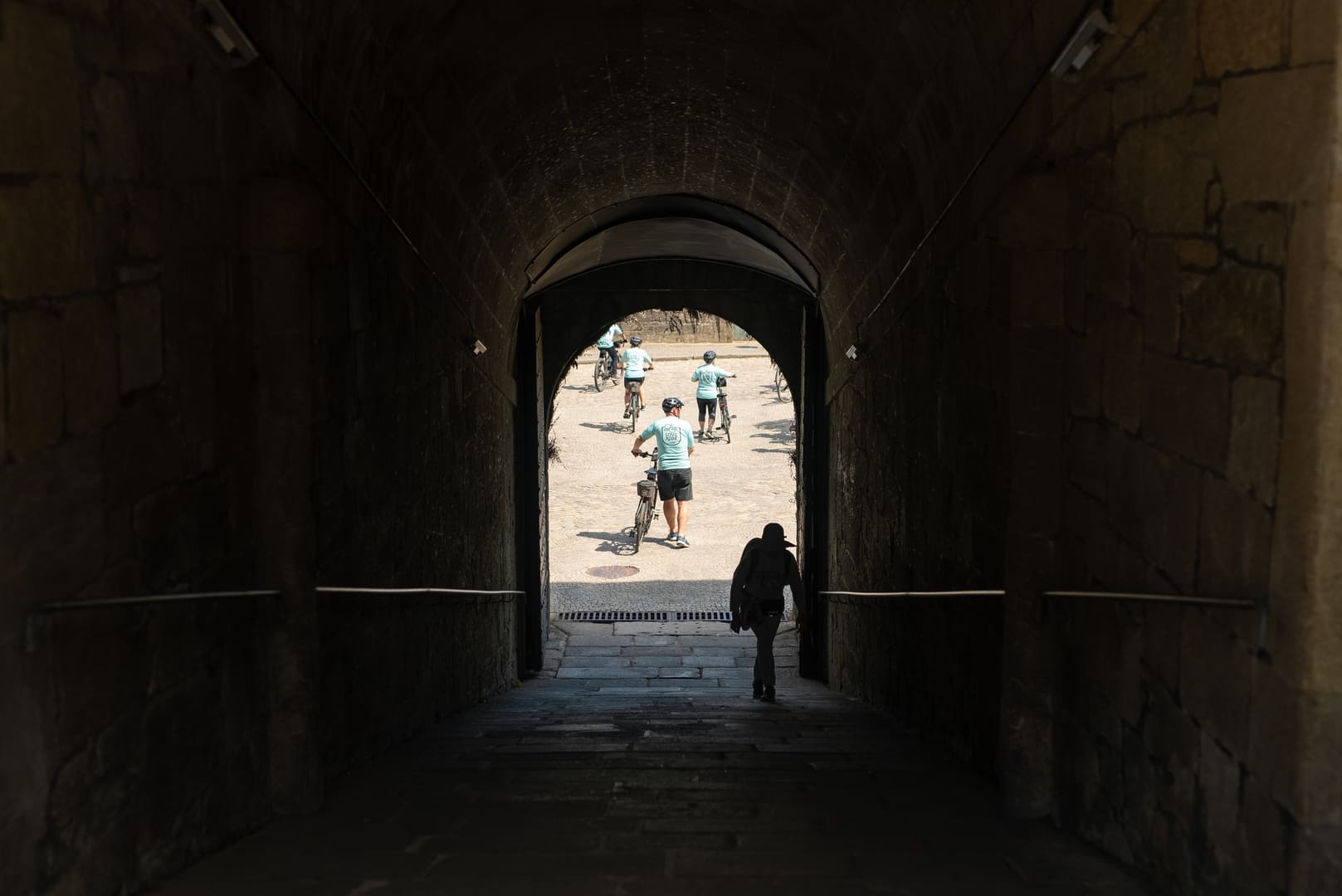
Inside Valença’s fortress
The transition into Spain couldn’t be more satisfying.
From Valença, you cross the International Bridge over the Minho River and enter Tui.
Unlike crossing a border by car or plane, crossing it by bicycle gives you time to notice the moment.
Tui’s Cathedral dominates the old town above the river and makes a natural first stop in Galicia.
From here, the Camino continues through woodland, villages and rural landscapes towards O Porriño and Redondela.
Around Redondela, the Central and Coastal Portuguese Caminos come together.
The change is noticeable.
There are more pilgrims now, and the sense of everyone gradually converging on Santiago becomes stronger.
From Redondela, the route continues through Ponte Sampaio before eventually reaching Pontevedra.
Live Love Ride insider tip: Once you’ve checked in, swap cycling shoes for something comfortable and explore Pontevedra’s historic centre on foot in the late afternoon. Its largely pedestrian old town is full of small squares, granite arcades and places for a drink or tapas. It’s one of our favourite evenings on the Camino.
Leaving Pontevedra, the route moves through classic Galician scenery.
Woodland, stone villages, farmland and short climbs create a constantly changing ride.
Caldas de Reis provides a natural stopping point before you continue towards the Ulla River and Padrón.
By now, the Camino has a different atmosphere from the quieter Portuguese stages.
Pilgrims travelling on different Portuguese routes have converged, and everyone is heading towards the same destination.
Padrón itself has deep connections with the traditions surrounding Saint James.
It also has one of Galicia’s most famous contributions to the table.
Live Love Ride insider tip: This is the night to order pimientos de Padrón, the little green peppers associated with the town. The traditional saying is unos pican e outros non: some are hot and others aren’t. Pair them with pulpo a la gallega, octopus with olive oil, salt and paprika, for a very Galician post-ride dinner.
The final stage is shorter than some of the days behind you, but Santiago doesn’t give itself away for free.
There are still climbs between Padrón and the city.
As you get closer, rural Galicia gradually gives way to the outskirts of Santiago and the number of pilgrims increases.
After days of following yellow arrows, the destination stops being an abstract point on the GPS.
Then you enter the historic centre.
The streets lead towards the Cathedral and eventually open onto the Praza do Obradoiro.
Arriving here by bicycle after travelling from Porto through the interior of northern Portugal is the moment the entire route has been building towards.
Don’t immediately start thinking about what comes next.
Stay in the square for a while.
Live Love Ride insider tip: Start early enough to aim for a morning arrival in Santiago. If you would like to experience the Pilgrim’s Mass, check the Cathedral’s current schedule before your trip and plan accordingly; the traditional midday celebration is often at 12:00. Arriving before lunch also gives you time to enjoy the square, take care of your pilgrim formalities and experience Santiago without rushing.
Give Santiago a day of its own.
Visit the Cathedral, wander through the historic streets and enjoy the strange pleasure of waking up without needing to follow another yellow arrow.
If you have carried a pilgrim credential and fulfilled the current requirements, you can also visit the Pilgrim’s Office regarding your Compostela.
After days of moving through landscapes at cycling speed, Santiago is a good place to slow down.
Cyclists can carry the same credencial, or pilgrim passport, used by pilgrims travelling on foot. Along the route, you collect stamps from churches, accommodations, cafés and other participating locations.
By the time you reach Santiago, the credential becomes a wonderfully analogue record of where you have been.
If receiving the official Compostela is important to you, check the current requirements of the Pilgrim’s Office before travelling. Requirements can change and cyclists should pay particular attention to the minimum qualifying distance and stamp requirements.
The credential is worth carrying even if receiving the certificate isn’t your primary motivation. It becomes part of the ritual of the journey.
The Central Camino rewards local knowledge.
Its combination of rural roads, historic tracks, cobbles, woodland and more rugged terrain means there can be a significant difference between knowing where the Camino goes and knowing how to make that Camino work well by bicycle.
Live Love Ride specializes in premium bike tours in Portugal, and our Porto Bike Station is permanently staffed by our local team, close to the Portuguese Camino.
Our guides and support team are regularly out on these routes, guiding guests, scouting conditions and supporting self-guided riders as they travel north. That means our Camino operation isn’t being managed remotely. We have people, bikes and technical knowledge based close to where our guests are riding.
We also maintain a specialized premium bicycle fleet with e-bike, gravel, mountain bike and touring options.
That choice matters particularly on the Central Camino.
A confident cyclist looking for a more adventurous experience may prefer a gravel or mountain bike. Another guest may be much happier on an e-bike with a cycling-optimized route. Matching the bicycle and route to the rider is part of designing the journey properly.
Before guests arrive, our team scouts and refines the routes, selects appropriate daily distances and prepares cycling-specific GPS navigation. During the trip, our local operation remains available for support.
The objective isn’t to make the Camino feel packaged.
It’s to take care of the things that can get in the way of experiencing it.
Choose the Central Camino if you want to experience a more inland, rural and historic side of northern Portugal and don’t mind working a little harder for it.
This is a route of old towns and small villages, granite bridges and cobbled lanes, vineyards and forest tracks.
It is more rugged than the Coastal Camino and, in places, more physically and technically demanding.
But that is also what gives it its character.
Ponte de Lima is one of the most beautiful stops on any Portuguese cycling journey. The ride north through the Minho takes you through landscapes most visitors to Portugal never experience. And reaching the walls of Valença, with Spain visible across the river, provides one of the great moments of the Portuguese Way.
Then you cross into Galicia and join the growing stream of pilgrims moving towards Santiago.
For riders looking for the traditional inland Portuguese Camino by bike, this is the route we would choose.
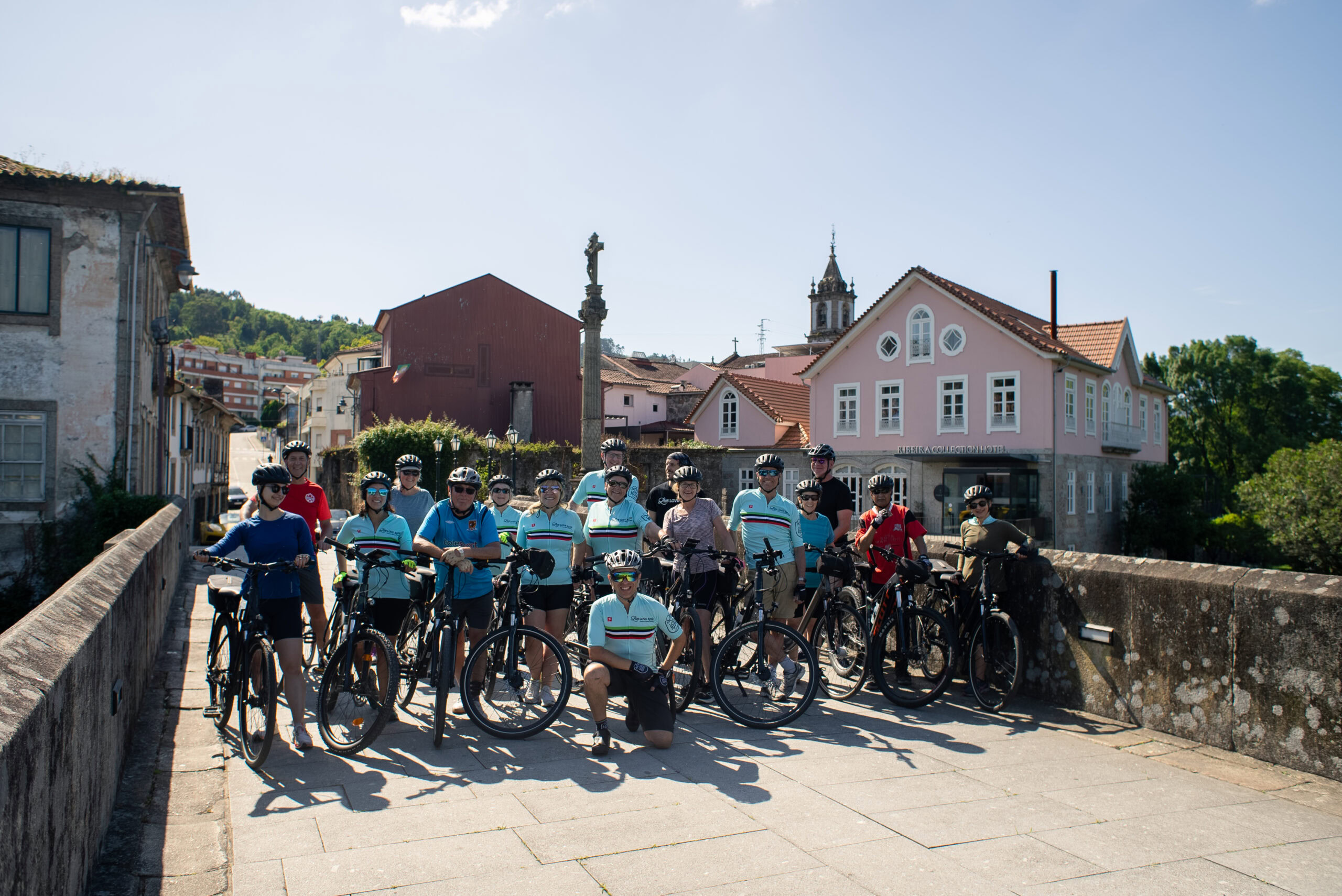
Group picture on the historical bridge over the Lima river
Explore our Central Portuguese Camino bike tour from Porto to Santiago to see the complete itinerary, accommodations, premium bike options and support available with Live Love Ride.
Still deciding between the inland and coastal routes? Read our guide to cycling the Portuguese Coastal Camino, or explore all our Camino de Santiago bike tours to discover the different ways to ride from Portugal to Santiago.
And if the Camino has made you curious about what else Portugal has to offer on two wheels, explore our Cycling destinations in Portugal, from the Douro Valley and Alentejo to the Algarve and beyond.
The Portuguese Central Camino is only one way to experience the Camino with Live Love Ride. Different routes, distances and even different ways of travelling can reveal a completely different side of the pilgrimage.
If you would rather experience the Camino at a slower pace, explore our Portuguese Camino de Santiago walking tours, designed for travellers who want to follow the route on foot while enjoying carefully selected accommodations, luggage transfers and local support along the way.
Or, if you are looking for a different Camino cycling experience in Spain, discover our Camino de Santiago bike tour from León, following the iconic Camino Francés through northern Spain towards Santiago de Compostela. It is a very different journey from the Portuguese Way, with its own landscapes, traditions and cycling challenges.